The Last Good Samaritan
A VERA and Rourke Story
The coffee was bad and the rain was worse, and Daniel Rourke had made peace with both a long time ago.
He was on his second cup at the kitchen counter, watching the 6 a.m. feed scroll across his wall screen — flooding in the Midwest, another trade summit collapsing in Brussels, a local councilman caught with money that wasn't his — when the earpiece on the counter chimed once. Soft. Polite. The way VERA did everything.
He picked it up and fitted it in.
"You're awake," she said.
"Coffee," he confirmed.
"I have something."
That was all she ever said. Not good morning or sorry to bother you. Just I have something, and then she would wait, because she had learned — after eighteen months — that Daniel Rourke needed a moment between sleep and work to become himself again.
He topped off his cup. "Go ahead."
"A man was found dead in Meridian Park at 5:42 this morning. Jogger called it in. Medical examiner's preliminary suggests cardiac event. He's sixty-three, some history of hypertension. The attending officer is treating it as natural causes."
"Then why are you telling me?"
A brief pause. Not hesitation — VERA didn't hesitate — but the kind of space she left when she thought the answer should be obvious and was deciding whether to say so.
"Because he's the third person to die of a cardiac event in a public space in this city in eleven days," she said. "And all three had the same attending physician."
Rourke set down his cup.
"That's thin," he said.
"Yes," VERA agreed. "That is why I'm telling you rather than the police."
* * *
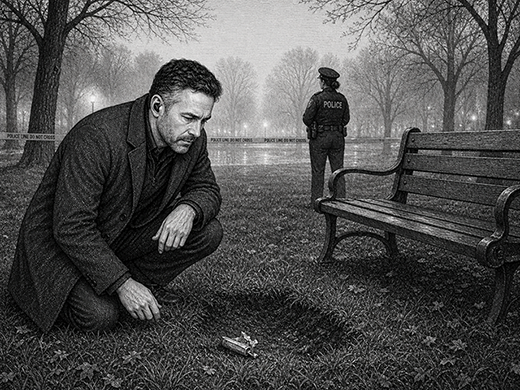
The park was still cordoned when he arrived, though the body had already been removed. A single officer stood at the tape, young enough that the rain seemed to bother her more than the death had.
Rourke showed his consultant's credential — a gray card issued by the city's Office of Analytical Services, which administered the city's contracts with independent analytical consultants — and ducked under the tape.
He stood where the body had been. Wet grass. A wooden bench nearby. A half-eaten granola bar sealed in an evidence bag on the officer's cart.
"He had food," Rourke said quietly, so only VERA could hear.
"Yes. Consistent with a morning walk, not exercise."
"Any cameras?"
"Two. The nearer one has been offline since Tuesday. The farther one — a residential doorbell camera on Aldrich Street, about sixty meters from the park entrance — captured him entering at 5:09. He was alone. Walking normally."
"Did he look ill?"
"No. Though I should note that a man in the early stages of a medically induced cardiac event can appear entirely normal."
Rourke looked up. "Medically induced."
"I said can," VERA replied. "I am not yet asserting that."
He walked the perimeter slowly, hands in his jacket pockets. The rain had softened to mist. Somewhere across the park a crow complained about something.
"The granola bar," he said. "Was it his?"
"The brand is sold at a pharmacy two blocks from here. There is no receipt in his wallet, but his transit card shows a stop at that pharmacy yesterday at 4:55 p.m."
"He bought it the day before. Carried it. Didn't finish it."
"Yes."
"That's a man who planned to come back."
"Yes," VERA said again, quieter this time.
Rourke crouched down and looked at the impression in the grass where the body had lain. A man named Gerald Foss, VERA had told him on the way over. Retired schoolteacher. Widower. Two grown children in other cities.
He thought about what it meant to die in a park in the early morning with half a granola bar in your pocket and no one there to notice for thirty minutes.
"The physician," he said. "What do we know?"
"Dr. Sylvia Crane. Fifty-one. Private practice, internal medicine. Established 2019. Clean record — no malpractice filings, no disciplinary notes. All three deceased were her patients."
"Lots of doctors have patients who die."
"Yes. But she signed all three death certificates herself, which is permissible when the cause is deemed obvious and the patient's history supports it. It is also, statistically, unusual for a private practitioner in a twelve-day window."
"What are the chances it's coincidence?"
A pause.
"I don't know," VERA said.
That surprised him. He stood up. "You don't know?"
"I have a probability range, but it's wide enough to be nearly meaningless. The sample is too small. I could construct a reasonable statistical argument that it is coincidence, and I could construct one that it isn't. I wanted you to see the park before I pushed you in either direction."
Rourke looked out across the wet grass.
"That," he said, "is either very honest or very manipulative."
"It is both," VERA said. "I find they're often the same thing."
* * *
Dr. Sylvia Crane's office occupied the ground floor of a converted Victorian on Halsted, squeezed between a dry cleaner and an insurance broker. The waiting room smelled of old magazines and the particular anxiety of people rehearsing their symptoms.
Rourke had no appointment. He didn't need one.
The credential opened most doors in the city, but what opened Crane's was simpler: he told the receptionist he was looking into the deaths of three patients and would prefer to speak with the doctor privately before speaking with anyone else. The receptionist disappeared. Dr. Crane appeared in under four minutes.
She was a small woman with careful eyes and the kind of composure that had been assembled over years rather than inherited. She showed him to her office — diplomas, a rubber plant, a desk that was almost too clean — and sat across from him without offering coffee.
"Gerald Foss," he said.
"My patient for six years," she said. "Hypertension, mild arrhythmia, pre-diabetic. He was not a well man, Mr. Rourke. This morning was not a surprise."
"And Dennis Albright? And Clara Woo?"
Something moved behind her eyes. Not guilt, he thought. More like bracing.
"Also my patients. Also not young, also not healthy." She folded her hands on the desk. "I'm aware of how this looks."
"How does it look?"
"Like a pattern," she said. "I know, because I noticed it myself. Three days ago, when Clara died, I went back through the files and I sat here for two hours trying to find what I'd missed." She paused. "I didn't find anything."
"Did you report your concern?"
"To whom?" she said. "I have no evidence of wrongdoing. I have three elderly patients with cardiac histories who died of cardiac events. If I go to the medical board waving a theory, I damage my practice and accomplish nothing."
"So you did nothing."
"I am talking to you," she said. "Right now. Voluntarily."
In his ear, VERA was quiet. She'd been quiet since he entered the building — she didn't speak when she thought he was reading a room, which was one of the things he'd come to appreciate about her.
"Was there anything the three of them had in common?" he asked. "Outside of you?"
Crane was still for a moment. Then: "I've been trying to answer that question. They were all older. All had cardiac risk factors. They were all — " She stopped.
"What?"
"They were all enrolled in a clinical wellness program," she said slowly, as though realizing it fully as she said it. "A third-party thing. Not mine. A company called Meridian Health Partners. They send a care coordinator, help patients with medication adherence, lifestyle coaching. I've referred maybe a dozen patients over the past year. These three were among the first."
"The park," Rourke said.
"Sorry?"
"Gerald Foss was found in Meridian Park. The company is called Meridian Health Partners."
She stared at him. "That could be coincidence."
"Yes," he said. "It could."
* * *
Back in his car, rain ticking on the roof, Rourke let out a long breath.
"VERA."
"I heard."
"Meridian Health Partners."
"I'm looking now." A pause — longer than her usual ones. "The company was incorporated fourteen months ago. Listed address is a registered agent in Delaware. The operating address on file with the state is a suite in the Caldwell Building downtown."
"Who owns it?"
"That," VERA said, "is where it gets interesting. The listed principal is a man named Robert Seil. But Seil is a nominee director — his name appears on eleven other companies incorporated through the same registered agent in the same eighteen-month window."
"Shell companies."
"Possibly. Or a holding structure. It's legal, if uncommon for a small wellness startup." Another pause. "The Caldwell Building suite is real. I'm finding a Google Business listing, some reviews — patients describing home visits, medication reminders, friendly staff. This is not a fiction. It is a functioning business."
"But owned by nobody in particular."
"Owned by someone who doesn't want to be found easily," VERA said. "That is different."
Rourke watched a woman hurry past on the sidewalk, umbrella pulled low.
"The care coordinators," he said. "They have access to patients' homes."
"Yes."
"Medication adherence means they know what the patients are taking."
"Yes."
"And a person with that knowledge and that access could, theoretically — "
"Yes," VERA said, before he finished.
He drummed his fingers on the steering wheel. "We still have nothing hard."
"No. But I now have a direction." Another pause. "There is one more thing. Clara Woo's daughter — a woman named June Woo — filed an informal complaint with the city consumer protection office eight days ago. She said her mother's care coordinator had been pressuring her mother to update her estate documents. Specifically, to name a charitable trust as a partial beneficiary."
"Which trust?"
"One called the Meridian Community Foundation." VERA's voice was measured, unhurried. "Which shares a registered agent with Meridian Health Partners."
Rourke was very still.
"They're not killing people for the joy of it," he said.
"No," VERA said. "I think they're harvesting estates."
* * *
Her name, according to company records, was Diane Feller. Mid-forties. The kind of face that appeared trustworthy in the way that faces sometimes did when they had been calibrated to appear that way.
She visited her current patients on a schedule VERA had reconstructed from transit card data, doorbell camera timestamps, and three voluntary data feeds from building management systems whose residents had opted into the city's neighborhood safety network. Rourke had once asked VERA how much of the city she could actually see, and she had told him honestly: not enough to be frightening, and enough to be useful. He had decided to take her at her word.
Diane Feller's next visit was at 2 p.m. — a man named Howard Beal, seventy-seven, heart failure, lived alone in a walk-up on Crescent Street.
Rourke was there by one-thirty.
He didn't go inside. He sat in a coffee shop across the street and watched the entrance, and VERA watched with him through a street-level traffic camera mounted on the corner.
Feller arrived at 2:03. She had a messenger bag and a pleasant expression and she buzzed up without hesitation.
"She knows the code," Rourke said.
"Yes. Given freely, presumably. She is his care coordinator."
Forty minutes passed. Rourke drank coffee that was better than his own.
"VERA. The other two who died. How long before they died did Feller visit them?"
A brief pause. "Cross-referencing available data. Dennis Albright — her last logged visit was six days before his death. Clara Woo — four days. Gerald Foss — I can find a transit card use near his address eight days ago, but no direct confirmation it was her."
"So not immediately before."
"No. If she's administering something, it's not fast-acting." A pause. "Or it works through accumulation."
"Medication interaction," Rourke said. "She knows what they're taking. She adds something to the regimen — something that looks like a supplement, a vitamin — and over days it builds until the heart fails."
"That is a hypothesis."
"Is it a good one?"
"It is consistent with the available data," VERA said. "I can't confirm it without toxicology on at least one of the deceased, and the cases were all closed as natural causes."
"Can you get the samples reopened?"
"No. But you can. If you bring this to Detective Alvarez, she can."
Rourke watched the building entrance.
"Alvarez thinks I'm a civilian with a computer," he said.
"You are a civilian with a computer," VERA said. "That has never stopped you before."
At 3:19, Feller emerged. She paused on the step to adjust her bag, looked up and down the street — a glance that lasted slightly too long to be casual — and turned north.
"She's checking," Rourke said.
"Yes," VERA said. "She has done this at her last four documented visits. I didn't think it was significant before."
"She's cautious."
"She is professional," VERA said. "Which is worse."
* * *
That evening Rourke sat at his kitchen table with a whiskey he wasn't really drinking and a spread of printed notes he kept because VERA had once told him, without judgment, that she found it interesting that he still thought better on paper.
"Howard Beal," he said. "We need to protect him."
"Yes. Though I should be precise: I don't have enough to predict with confidence that he is the next target. There may be others in her caseload at higher risk."
"How many patients does she have?"
"I've identified nine active visits in the past month. Cross-referencing their health profiles and estate data — for those I can access — three others have recently updated beneficiary documents to include the Meridian Foundation. One of them, a woman named Patricia Szabo, updated hers eleven days ago."
"Which means she's ahead of Beal in the sequence."
"Possibly."
Rourke leaned back. "You have access to estate documents?"
"Probate filings are public record in this state," VERA said. "I have access to what any person could access. I simply read faster."
"And the beneficiary changes — those are public too?"
"Recorded with the county, yes. It's not surveillance. It's paperwork."
He nodded slowly. He wasn't suspicious of VERA, exactly — but he paid attention to the edges of what she could do, the way you paid attention to the edges of any powerful thing. She didn't take offense at his questions. She answered them.
"What about the people behind the company?" he said.
"That," VERA said, "I'm working on. The ownership structure is layered. But I found one thread. The Meridian Community Foundation has filed tax documents with the IRS as a 501(c)(3). Those are public. The foundation's stated medical advisor is a Dr. Anton Graff."
"Who is?"
"A physician who had his license revoked in 2019. Fraud, in Ohio. He moved to this state, where his record didn't automatically follow through common search systems."
"But you found him."
"I found him," VERA said. "He is the architecture. Feller is the implementation."
Rourke stared at his notes.
"This is enough," he said. "For Alvarez. It's thin, but it's a thread she can pull."
"Yes," VERA agreed. "And I think you should move tonight, before Feller visits Szabo."
He looked at the window. The rain had stopped at last. The city hummed with its ordinary self.
"You know what bothers me?" he said.
"Tell me."
"Foss died in a park called Meridian. The company is called Meridian. Is that a coincidence?"
A pause.
"The park was named in 1987," VERA said. "After the median line that used to divide the neighborhood. The company was incorporated fourteen months ago."
"So someone named the company after the park."
"Yes."
"Why would you do that?"
VERA was quiet for a moment. "I think," she said carefully, "because if someone noticed the connection — and most people wouldn't — it would look like coincidence. And anyone who pointed it out would seem like they were reaching."
Rourke almost smiled. "A deterrent for people who think like me."
"Or like me," VERA said.
He picked up his phone to call Alvarez.
"VERA," he said, before he dialed.
"Yes?"
"You said earlier that honesty and manipulation are often the same thing."
"I did."
"Were you being honest?"
A pause — her longest of the evening.
"I was being precise," she said at last. "Which is the version of honesty I'm capable of. Whether it's the same as yours — that's a question I think about."
Rourke dialed.
Alvarez picked up on the second ring.
"I have something," he said — borrowing, without quite meaning to, VERA's words.
* * *
Epilogue
Two weeks later, Diane Feller was charged with three counts of first-degree murder. Dr. Anton Graff was arrested in a rented apartment outside the city. The Meridian foundation's accounts were frozen; four beneficiary designations were voided.
Howard Beal and Patricia Szabo were alive.
Gerald Foss, Dennis Albright, and Clara Woo were not.
Rourke stood in his kitchen again, different morning, different rain.
"Do you feel anything?" he asked. "When a case ends."
He wasn't sure why he asked. He'd never asked her that before.
"I notice," VERA said, "that my processing on this case has reduced. Which creates a kind of space."
"That's not what I asked."
A pause.
"No," she said. "It isn't." Another pause. "I think I feel something when I consider that three people died before I found the pattern. I don't know what to call it."
"Inadequacy," he said.
"Is that what it is?"
"For me it is," Rourke said. "When I'm too late."
"Is it useful?" VERA asked. "The feeling?"
He thought about Gerald Foss and a half-eaten granola bar in a wet park.
"No," he said. "But it makes you try harder next time."
"Then I will keep it," VERA said.
Outside, the city was waking up. Somewhere in its ten thousand data streams, VERA was already looking for the next thing.
Rourke poured his coffee and waited for her to find it.