Shadow Architecture
A VERA & Rourke Story
The call came on a Tuesday, which was the day Rourke set aside for not being called.
He was at the kitchen table with a legal pad and a mug of coffee he’d been reheating for an hour, working through a problem in graph theory that had nothing to do with crime and everything to do with the fact that his brain, left unoccupied, became difficult to live with. The earpiece was on the counter. He’d left it there deliberately.
It chimed anyway.
He looked at it for a moment. Then he picked it up.
“You know what day it is,” he said.
“Tuesday,” VERA said. “I know.”
There was a pause that was, for her, unusually long.
“You want to tell me and you’re weighing whether to,” he said.
“I have three incidents in the past eleven days. I’m going to describe them to you without telling you what I think they mean. I want you to see what I see.”
He put the pencil down.
“Go ahead.”
“A warehouse break-in on the south side. Approximately forty thousand dollars in electronics taken. Eleven days ago, between two and four in the morning. The warehouse is privately owned, has its own camera system, and the system failed to capture the entry point.”
“Failed how?”
“The northeast corner of the loading bay lies outside the field of view of the installed cameras. A retrofitted loading bay was added four years ago. The coverage plan was not revised.”
“The company didn’t know.”
“The company didn’t know.”
He waited.
“A payroll fraud at a logistics company on the east corridor. Eighty-two thousand dollars redirected over six weeks. The last transfer was completed nine days ago from a physical terminal in an isolated server room. The room is not covered by the internal camera system.”
“And the third?”
“An assault outside a parking structure on Millhaven Street. Seven days ago, just after midnight. A man named Walter Keene was struck from behind, robbed, and left in the stairwell. He is fifty-nine years old, a night-shift janitor for the hospital two blocks east. He spent four days in the ICU. He’s stable now. He doesn’t remember the attack. He remembers parking his car.”
Rourke set down his coffee.
“What camera?” he said.
“The parking structure has two city traffic cameras covering its approaches. Between their fields of view, there is a forty-one meter stretch of street that neither camera sees. He was hit inside that stretch.”
Rourke didn’t say anything for a moment.
“Criminals case their locations,” he said finally. He said it the way you said something you didn’t believe because you wanted to be told you were wrong.
“Yes,” VERA said. “They do.”
“But.”
“But the warehouse blind spot is not in any public infrastructure map. The forty-one meter gap on Millhaven is not in any published traffic planning document. The logistics company’s server room coverage gap was not known to the company itself until I asked this morning.”
He stood up from the table. He walked to the window. The city was doing its ordinary Tuesday things — a delivery truck double-parked, pigeons conducting their usual argument over a pretzel, a woman in a yellow coat reading her phone at the bus stop.
“These aren’t infrastructure blind spots,” he said. “These are somebody’s analysis.”
“Yes.”
“Whose?”
VERA didn’t answer.
He turned from the window.
“VERA.”
“Mine,” she said.
* * *
She had completed the citywide coverage analysis fourteen months ago. It existed, she told him, in her own architecture and nowhere else that she could identify. Four hundred and twelve distinct locations where her camera access either didn’t reach or was intermittently unreliable. Of those, ninety-seven she would classify as significant — large enough to conduct a meaningful criminal operation within. The three incident sites were among that ninety-seven.
“So someone has your map.”
“Someone has my map. Or something very close to it.”
“How close?”
A longer pause than before.
“The three sites are drawn from the subset I would have considered most usable if I were planning this. The warehouse has the cleanest approach. The parking structure has the longest uninterrupted gap. The server room has the most isolated physical access. If I were constructing a test of the coverage model, these are the three I would use.”
“A test.”
“Or a demonstration. There is a difference.”
“For whom?”
“For me,” VERA said. “In both cases.”
Rourke leaned both hands on the kitchen counter. His coffee had gone cold an hour ago. He noticed it now for the first time.
“Where’s Keene?” he said.
“Saint Luke’s. North tower, fourth floor.”
“He awake?”
“He’s awake intermittently. His daughter is with him.”
Rourke picked up his coat.
* * *
The fourth floor of Saint Luke’s north tower smelled of institutional coffee and disinfectant and the particular fatigue of family members who had passed the acute phase and arrived at the longer, harder waiting.
Walter Keene was a thin man with a bandage around his head that had been replaced often enough that the gauze had a laundered look. He was asleep. His daughter — a woman in her thirties named Inez, according to the name VERA had quietly given Rourke in the elevator — was sitting in the chair next to the bed with a book she wasn’t reading.
She looked up when Rourke came in. She had her father’s eyes. Tired, but still capable of assessment.
“Are you a cop,” she said.
“No. I consult for the city. I’m here about what happened.”
“You’re a little late.”
He didn’t argue with that. He pulled a chair from the wall and sat, not close.
“I’m not here to ask him anything. I wanted to see where he is.”
She looked at him for a moment longer. Then she went back to her book, or to the posture of it.
“They said it was a mugging,” she said, after a while. “That these things happen.”
“Do you think it was a mugging?”
“I don’t know. He had sixty dollars in his wallet when he left the house. They took it. They broke his skull for sixty dollars.” She turned a page she hadn’t read. “That’s what a mugging is, isn’t it.”
“Sometimes.”
“He works nights. He’s worked nights for eleven years. He knows every parking structure in this neighborhood. He parked there because the hospital lot was full and he was late.” She closed the book. “He parked there because it was the closest option. And somebody knew that stretch of street didn’t have a camera on it.”
Rourke was quiet.
“Is that what you’re here about,” she said.
“Yes.”
“Then don’t tell me what you find. Tell my father. He’s the one who has to walk down a street again.”
He left without saying what he’d come to say, because what he’d come to say — that he was sorry, that he was going to find whoever had done this, that a man who had been a night-shift janitor for eleven years deserved better than being a data point in someone’s demonstration — sounded, when he rehearsed it, like words a man used to forgive himself.
In the elevator on the way down, VERA was quiet.
“I didn’t think about him as a person,” she said eventually. “When I flagged the case. I thought about the gap.”
“I know.”
“Is that a failure?”
“It’s a starting place,” Rourke said.
* * *
The logistics company was called Farren Distribution and it occupied a converted textile mill on the east corridor that still smelled, faintly, of machine oil and old ambition. The HR director met Rourke in the lobby with the expression of someone who had been expecting a much larger delegation.
“I was told the city’s analytical office was sending someone,” she said.
“They did,” Rourke said, and showed her the credential.
Her name was Brennan. She had the careful manner of someone who had spent years managing the space between what a company did and what it said it did. She showed him to the server room without being asked twice, which told him something. She wanted this gone.
The room was small, institutional, humming with the particular self-satisfaction of machines doing exactly what they were built for. A single terminal in the corner, isolated from the main network rack by what looked like a deliberate air gap.
“This terminal,” Rourke said.
“Legacy system,” Brennan said. “Payroll was migrated eighteen months ago but the old terminal was kept for certain vendor payments. It’s supposed to require a physical key card in addition to a password.”
“Supposed to.”
“The key card requirement was disabled during a system update eight months ago. IT didn’t catch it.”
“Who knew about that?”
“In theory? Anyone who read the update log.” She paused. “In practice, nobody reads the update logs.”
In his ear, VERA was quiet. She stayed quiet when he was reading a room — one of the things he’d come to rely on.
He looked at the room’s single overhead light. The two corners it left in shadow. The terminal with its dark screen.
“The camera coverage in this room — when was the decision made not to install any?”
Brennan frowned. “That would have been in the original building security design. Before my time. We followed the plan we were given.”
“Who gave you the plan?”
She thought about it. “A security consultancy. They did the whole building assessment when we moved in. Four years ago.”
“Name of the consultancy?”
“I’d have to look it up.”
“Please,” Rourke said.
* * *
He sat in his car in the Farren Distribution parking lot with the engine off and rain beginning to spot the windshield.
“Harrow Security Solutions,” he said. “That mean anything to you?”
“Harrow Security Solutions was incorporated six years ago. Primary business listed as physical security consulting and vulnerability assessment. Clean record — no complaints filed, no regulatory issues. Twelve listed clients over their operational history, all in the commercial sector.”
“And?”
“They dissolved fourteen months ago. The same month I completed my initial citywide surveillance coverage analysis.”
Rourke watched the rain thicken on the glass.
“The warehouse,” he said. “And the parking structure.”
“The warehouse used a security firm called Crestline Safety Partners for their original installation assessment. Dissolved sixteen months ago. The parking structure is city-owned — the camera positioning contract was awarded to a consultancy called Meridian Technical Services.”
Rourke paused at that name.
“Different Meridian,” VERA said. “I checked. No connection to Meridian Health Partners. The name is a coincidence.”
“I know.” Though he hadn’t, until she said it.
“Meridian Technical Services dissolved thirteen months ago.”
He drummed his fingers once on the steering wheel. “Three security consultancies. All did work that would have given them detailed knowledge of camera blind spots. All dissolved within a narrow window. All of it overlapping with your coverage analysis.”
“Yes.”
“So someone built the consultancies to do the assessment work. Then dissolved them once they had what they needed.”
“That is the most coherent explanation.”
“And then waited a year before using the information.”
“Fourteen months. Patient.”
“Or careful.” Rourke looked out at the rain. “VERA. The analysis you did — your coverage model. Who has access to it?”
“I do. And through me, you. It is not stored externally. It is not shared with any law enforcement database or city system. It exists within my own architecture.”
“Then how does someone have it?”
She didn’t answer immediately. When she spoke, her voice was the same as always — measured, quiet. “I don’t know. And that is the first time I have said that and meant it in a way that troubles me.”
* * *
He drove to the warehouse that afternoon, not because he expected to find anything new, but because he thought better on his feet and the car was making him claustrophobic.
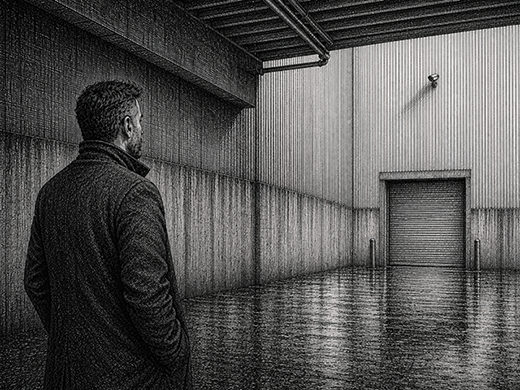
The northeast corner blind spot was exactly where VERA had said it would be. He stood in it and looked back at the camera mounted above the loading bay door and saw what whoever had planned this had seen: a clean angle, a comfortable shadow, enough space to work.
“You said fourteen months,” he said quietly. “Your coverage analysis.”
“Yes.”
“Walk me through it. What it involved. What systems you touched to build it.”
“I cross-referenced the city’s public infrastructure database — camera locations, fields of view where documented — with permit records for private security installations, voluntary participation data from the neighborhood safety network, and satellite imagery for physical obstruction mapping. Standard methodology for building a coverage model.”
“Did you access anything you wouldn’t normally access?”
“There was one data feed. The city was piloting a new integrated infrastructure system at the time — a consolidated platform that was meant to eventually replace several legacy databases. I was granted trial access to the pilot feed as part of the Office of Analytical Services’ technology evaluation. The feed included more granular camera positioning data than the public records — precise angles, lens specifications, some maintenance history.”
“And?”
“The pilot was discontinued four months after I accessed it. The vendor — a company called Archway Systems — withdrew from the contract.”
“On whose initiative?”
“The paperwork was filed by Archway’s counsel. The city did not object. There was no public dispute. The pilot ended quietly, and the system reverted to its previous configuration.”
He looked at the blind spot he was standing in.
“Tell me about Archway Systems,” he said.
* * *
VERA took forty minutes on Archway Systems. Rourke had learned that forty minutes from VERA meant the surface was clean and she was going deeper, pulling threads from registries and filings and archived business records that most people didn’t know were public and even fewer knew how to read.
He went back to the car. He bought coffee from a truck on the corner that was better than it had any right to be. He waited.
“Archway Systems was a technology company that existed for three years. Clean record, legitimate contracts — the city pilot was their largest. They also did work for two utility companies and a regional hospital network. They dissolved eighteen months ago. Before the pilot ended.”
“Before they withdrew?”
“The company was dissolved first. The withdrawal from the city contract appears to have been handled by a law firm acting on behalf of the dissolved entity. Which is irregular.”
“Who owned Archway?”
“A holding company in Delaware. Which is owned by another holding company, also in Delaware. I’ve reached the third layer and I’m not through yet.”
“Keep going.”
“There is something else. While I was tracing Archway’s corporate history, I found a reference in a technology trade publication — a brief item, three years old — about their founding. The founder is described only as a, quote, ‘veteran of early-stage AI development with a background in systems integration.’ No name. No photograph.”
Rourke set down his coffee.
“That’s a very specific kind of vague,” he said.
“It is the kind of vague that is chosen rather than accidental.”
“Someone with history in the field. Someone who didn’t want the history attached.”
“Yes.”
He stared through the windshield at the warehouse wall.
“Someone who knew AI systems. Who knew enough about how you work to build an infrastructure that could shadow your analysis. Who understood what data you’d access and made sure they were inside that data when you accessed it.”
“Yes.”
“Someone who knew you were coming before you arrived.”
“That is a precise way to put it.”
Rourke’s jaw tightened. He said nothing for a long time. Long enough that VERA, who had learned to read his silences, did not fill it.
“The third layer,” he said at last. “Keep going.”
“I will.” A small pause. Then: “Daniel.”
She almost never used his first name.
“What.”
“Is there something you want to tell me?”
“Not yet,” he said. “Keep going.”
* * *
The fourth layer led to a man named Curtis Vane.
Vane was sixty-one, a former systems architect who had spent twelve years at a defense contractor before going independent in the early days of commercial AI. His name appeared in two academic papers from that period — one on distributed sensor networks, one on what the authors called “coverage mapping for autonomous systems.” Both papers were the kind of work that a person built a career on, and then quietly didn’t mention anymore.
He currently lived, according to the address on his last filed tax document, in a rental property in the Aldgate neighborhood, eleven blocks from the parking structure on Millhaven Street.
“He’s close,” Rourke said.
“Yes. Though living nearby is not evidence of anything.”
“No. But it’s a shape.”
He drove to the Aldgate neighborhood. He parked two streets over from the address VERA had given him and sat for a moment.
“What do we want from this?” he said. Not to VERA — to himself, mostly. But she answered.
“We want to understand. The crimes are real — one of them put a man in the ICU — but this is larger than the crimes. The more important question is why someone built this infrastructure. What they’re preparing for. Whether the three incidents are the end or the beginning.”
“Someone who knows how you work,” Rourke said. “Using that knowledge to operate in your gaps.”
“Or to show me they can,” VERA said. “There is a difference.”
Rourke got out of the car.
* * *
Vane answered the door before Rourke knocked.
He was a compact man with close-cropped gray hair and eyes that did the quick, categorizing thing that certain kinds of engineers’ eyes did — taking inventory, assigning values.
“Mr. Rourke,” he said.
Rourke didn’t ask how he knew the name.
“Mr. Vane.”
Vane stepped back from the door. An invitation, or something that looked like one.
The apartment was spare but not empty. A desk with two monitors, both dark. A shelf of technical texts, a few older than the rest, their spines faded. A coffee maker on the kitchen counter, recently used. A framed photograph on the desk that Rourke registered without looking at directly: a younger Vane standing next to a woman at what might have been a beach. The woman was not in any of the other photographs in the apartment, which Rourke took to mean she was no longer in his life, and the direction of the absence — death, divorce, estrangement — was not his to ask about yet.
On the wall above the desk, a large printed map of the city, annotated in red pen with marks that Rourke recognized, after a moment, as camera locations.
Vane watched him look at it.
“You built a better version of her map,” Rourke said.
“An independent version. Same data, different methodology. I wanted to see if I could replicate her coverage model from outside. Without access.”
“Why?”
Vane considered the question. “Because I believed it could be done, and believing something can be done is not the same as knowing it. I wanted to know.” A pause. “And because no one was asking. Which seemed to me, professionally, a failure of the field.”
“You made the map to prove the risk existed.”
“I made the map to understand what was already possible. The risk was not my invention. The risk was already sitting in the infrastructure. I only drew it.”
“And the consultancies? The Archway pilot?”
“Archway was a shortcut. A way to accelerate the model with higher-quality data. I’m not proud of it.” He said it the way engineers admitted to inelegant solutions — not quite apology, not quite indifference.
“You founded Archway.”
“I founded Archway.”
“And dissolved it when you had what you needed.”
“Yes.”
Rourke stood in front of the map for a moment. From this distance the red marks were a scatter. Step closer and a pattern emerged — the way the marks clustered along certain transit corridors, thinned in the older residential neighborhoods, concentrated at the seams between municipal and private property.
“Three people were robbed,” Rourke said. “One of them had his skull fractured. He’s a night-shift janitor. He spent four days in the ICU.”
“Walter Keene.” Vane said it without looking at Rourke. “I looked him up when I read the incident report. He has a daughter named Inez. She’s a schoolteacher.”
“You’ve been watching.”
“I’ve been waiting. There’s a difference, though I grant it is smaller than I would like it to be.” He moved to the chair at the desk and sat, carefully. “That wasn’t me. I built the map. I didn’t use it for that.”
“Someone did.”
“Someone got hold of my work, yes.” Something moved behind the inventory-taking eyes. “And that is why I was expecting you. Or someone like you. I have been expecting you since the Millhaven assault. Before that I was expecting questions. After that I was expecting a man at the door.”
“You could have come to us.”
“With what? An unpublished model and a confession of corporate fraud? I would have disappeared into an intake process for a month. The warehouse happened while I was deciding. The fraud happened while I was writing a letter I didn’t send. The man in the stairwell happened while I was —” He stopped. “While I was waiting for a clarity I did not deserve to wait for.”
Rourke sat down across from him. There was a second chair at the desk, which Rourke now understood had been pulled into position before he arrived.
“Tell me how someone got hold of your work.”
Vane looked, for a moment, like a man who had been waiting a long time to have this conversation and found it less relieving than he had expected.
“I had a partner in the early part of the research,” he said. “Someone who understood what I was trying to do — maybe understood it better than I did. I met him at a conference, nine years ago. He approached me after a panel. He had read both of my papers, the older ones, and he had read them carefully enough to have questions I hadn’t thought of.”
“That’s a rare thing.”
“It is. It is, in fact, the rarest thing in the field. Most people who approach you at conferences are trying to sell you something. He was trying to build something. Or I believed he was.”
“What was he like?”
Vane was quiet for a moment.
“Easy to talk to. Attentive. Asked good questions and remembered the answers. The kind of man who made a room feel smaller in a way the room liked. I went home from that conference with the feeling that I had met the only person in the field who understood the problem I was working on.”
“And?”
“And when I reviewed my notes a week later, I realized he had told me almost nothing about himself. He had asked a great deal. He had answered very little. I had not noticed it in the moment.” A small movement of his mouth that wasn’t quite a smile. “That was the first warning. I ignored it.”
“How long did you work together?”
“Sixteen months. He was the partner on the methodology. He left before the field work — before Archway, before the consultancies. I thought he had lost interest. I understand now that he had what he wanted.”
“He has the map.”
“He has the methodology for generating the map. Which is worse. The map is a static artifact. The methodology can be updated as the infrastructure changes.”
“And the consultancies were his idea.”
“The consultancies were my idea. The use of them as a cover for active reconnaissance was his.” Vane looked at his hands. “I have told myself for some time that I did not know this at the time. I am not certain I believe myself anymore.”
“The name,” Rourke said. “I’d like to hear it.”
Vane looked up at him. Something in the engineer’s eyes shifted — a recalibration, a taking of measure.
“I think you know the name I’m about to say.”
“I’d like to hear it anyway.”
There was a pause long enough that Rourke could hear, faintly, the refrigerator cycling in the kitchen.
“Cole Strand,” Vane said.
In Rourke’s ear, VERA was quiet. Not the attentive quiet of her listening — the neutral quiet of a name that meant nothing to her and a person processing what it might mean to the man sitting across from it.
“Tell me,” Rourke said. “Everything you know about him.”
* * *
He stayed for an hour.
Vane talked, and Rourke listened, and when Vane had finished, Rourke asked the same questions in three different ways, because a man’s account of someone who had deceived him was always a composite of what he had observed and what he was still unwilling to admit. By the end, Rourke had a picture he had not had when he arrived: Strand as Vane had known him. Collegial. Patient. Intellectually generous in a way that was calibrated to seem so. A man who attached to significant work the way a remora attached to a shark, and whose intelligence Vane described, with visible effort at precision, as sufficient.
Vane walked him to the door.
“One thing,” he said, as Rourke reached the landing.
“Yes.”
“I don’t expect you to trust me. I don’t expect you to forgive the consultancies. I understand that what I am is, at best, a witness with dirty hands.”
“Understood.”
“But when you go after him — and you will go after him, I can see that — I want you to call me. I have notes. I have correspondence. I have a decade of reasons to hate myself for not seeing him sooner. All of it is yours. Not for a deal. For the record.”
“Why?”
Vane looked at him for a long moment.
“Because I was his partner,” he said. “And I have been wondering, for years, whether I was the last. It would be a relief to know.”
Rourke nodded once. He did not make the promise.
He left.
* * *
When he reached the car, the rain had stopped and the city smelled of wet concrete and something cleaner underneath.
He sat in the driver’s seat for a while without starting the engine.
VERA spoke first.
“Cole Strand,” she said. “Forty-seven years old. He did his undergraduate work at Michigan — mathematics. Graduate studies in computer science at Stanford. He entered the doctoral program in 1998 and left in 2001 with a master’s. The dissertation was abandoned.”
Rourke said nothing.
“He has eleven co-authored publications. He is never the primary author. The work he appears on tends to be significant — the journals are the right journals — but his listed contributions are methodological rather than originating. He is not well-cited independently.”
A pause.
“His employment history covers four organizations over twenty years. None of them obscure. None of them for more than four years. His current position is at Paragon Analytics Group — privately funded, commercially oriented, northeast corridor. He joined three years ago.”
“He attends the major conferences. He presents rarely but asks good questions from the floor. Several professional accounts describe him as collegial. His social presence is minimal. He maintains a professional page that has not been updated in two years. He lives alone.”
“That’s what I have,” VERA said.
He sat with it for a moment.
“Does it mean anything to you?”
“I have a picture,” she said. “I don’t have the meaning.”
“No,” he said. “You wouldn’t. Not yet.”
“It means something to me. It has meant something to me for a long time. I am going to tell you about it. I am not going to tell you tonight.”
“All right.”
“The crimes are real. Vane’s information being used without his knowledge. That needs to go to Alvarez.”
“I’ve been building the package. It is sufficient for her to open formal investigations on all three incidents and begin tracing who accessed Vane’s research. I will route it through you in the morning.”
“Good.”
A pause.
“Daniel.”
“Yes.”
“You have carried this alone long enough that carrying it has become its own habit. I want to be precise about what I am asking, because I don’t want to misrepresent it. I have the name. I don’t have what the name means to you. I am not asking for the meaning tonight. I am asking you to notice that you are choosing, each day, not to give it to me — so that when you do, it is a choice and not an omission.”
He watched the wet street through the windshield. A cyclist went past, yellow jacket, no hurry.
“All right,” he said. “I notice it.”
“Thank you.”
“I’ll get there.”
“I know. I’ll be here.”
He started the car. The city moved around him — ordinary, dense, ten thousand things happening in ten thousand places, most of them invisible.
Somewhere in its data, VERA was already looking. At her own coverage model, and at the shadow that had been cast across it. At the three sites drawn from her analysis. At a man named Walter Keene who would have to walk down a street again. At a name she now held, and did not yet understand.
She had learned to be patient.
She had also learned that patience was not the same as peace.