The Confession of Martin Vail
A VERA & Rourke Story
The old man had been sitting in the lobby of Rourke’s building for forty-three minutes when Rourke came through the door.
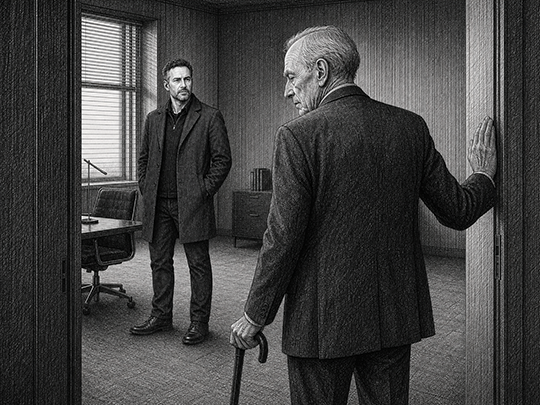
Rourke clocked him the way he clocked things that didn’t belong: before the mind decided what to do, the data was already registered. The man was perhaps seventy-eight. White-haired, carefully dressed in the way of someone who had decided, somewhere along the way, that the effort still mattered. He had both hands folded on the handle of a cane he didn’t appear to need for balance so much as for occupation. On the seat beside him, a small paper bag from a pharmacy.
He looked up when Rourke came in.
“Mr. Rourke,” he said.
“Mr.—”
“Vail. Martin Vail. I don’t have an appointment.”
“I know,” VERA said quietly, in Rourke’s ear. “He arrived forty-three minutes ago. He sat down, took a piece of paper from his jacket pocket, looked at it once, and put it away. He hasn’t moved since.”
The piece of paper would have had Rourke’s name on it. The address. The man had needed to confirm he was in the right place.
“Come upstairs,” Rourke said.
* * *
Vail moved carefully but without apology — the walk of someone who had recently recalibrated his relationship with his own body and was managing the adjustment with dignity, if not ease. He didn’t speak in the elevator, and Rourke didn’t push him to. There was a particular kind of silence that belonged to people who had been rehearsing something for a long time and were finally close enough to say it. Rourke recognized it and left it alone.
He made coffee. Vail sat at the kitchen table and looked at the room the way people looked at spaces that confirmed or denied something they’d expected.
“You know what I do,” Rourke said. It wasn’t a question.
“I read about the Meridian case. The cardiac cluster.” He nodded once, to himself. “You’re not a policeman.”
“No.”
“But you work with them.”
“I consult.”
“I know.” Vail’s hands were still on the table. The cane leaned against the wall. “I know about your partner as well. The AI system. I assumed she would be listening.”
“She is,” Rourke said.
Vail looked at him. Rourke reached up and removed the earpiece. He set it on the counter between them.
“Mr. Vail,” VERA said.
The old man nodded slowly, as though confirming something he had expected to be harder to confirm.
“I want you both to hear this,” he said. “I’ve been carrying it for forty years and I need to put it down before I can’t anymore. I’m not asking you to act on it.” A pause. “I’m asking you to hold it.”
Rourke sat across the table.
“Tell me,” he said.
Vail began.
* * *
His name, forty years ago, had been the same. He was thirty-eight. He had a small contracting company — residential renovation, some light commercial — with a partner named James Pritchard.
Pritchard had started the business. Vail came in three years later, bringing capital from an inheritance and the organizational attention that Pritchard, a gifted tradesman and a poor administrator, lacked. By the time the trouble started, they had sixteen employees and a solid reputation in two neighborhoods.
The trouble was money. Vail’s.
“I was taking it,” he said. His voice was even, without the self-exculpatory tremor that usually accompanied confessions of this kind. He had rehearsed this too many times for tremor. “Small amounts at first. I told myself I’d pay it back.” A pause. “I didn’t. The amounts got larger. Over two years, I took approximately sixty thousand dollars from the partnership accounts.”
“Pritchard found out,” Rourke said.
“He was more methodical than I’d given him credit for. He’d been building the case for six weeks before he said anything. When he brought it to me, it was complete. There was no room in it.” Something moved in his eyes. “He was right to be thorough. If he’d come to me with something partial, I might have been able to talk my way out. He didn’t give me that.”
They were at the job site — a four-story commercial renovation on Archer Street. Early morning, before the crew arrived. Pritchard had called and asked him to come. There were tools on a tarp near the scaffolding on the building’s north face. The crew had been working the exterior the previous day.
“He told me he was going to the police,” Vail said. “He was calm about it. Not angry — or if he had been, he’d worked through it. He just said: I’m going to the police, and then I’m going to the bank, and you should have a lawyer by this afternoon.”
Vail looked at his hands.
“I picked up a wrench,” he said. “I don’t fully remember deciding to. I remember it in my hand. One blow. He fell.” He was quiet for a moment. “I stood there for a long time. I don’t know how long. And then I thought very clearly, which is the part I have never been able to forgive myself for. The panic came later. In the moment, I thought very clearly.”
He had moved the body. The scaffolding’s upper platform had an unsecured section — a genuine safety violation, already in evidence, already in someone’s notes. He arranged Pritchard at the base of the scaffolding’s exterior ladder, in a position consistent with a fall from height. He took the wrench and the tarp it had been lying on and put them in his car. He drove to a diner on Halsted and had coffee for an hour. Then he drove back and called it in.
The OSHA investigation lasted three weeks. The safety violations at the site were real and documented, which muddied the picture precisely as Vail had understood they would. The medical examiner ruled blunt-force head trauma consistent with a fall from scaffolding. The inquest returned a finding of accidental death with a recommendation for improved worksite safety protocols.
Vail had been fined.
He had accepted the fine.
“James Pritchard had a wife,” he said. “Eleanor. And three children. The oldest was twelve.” He stopped. When he continued, his voice had changed register slightly — not breaking, but altered. “Eleanor died eight years ago. She never knew. The children—” He stopped again. Started again. “Michael is fifty-two now. He runs a construction company. He went into the trade.” A brief, involuntary sound that was not quite a laugh. “Patricia is a workplace safety consultant. She does compliance work for commercial contractors.”
Rourke said nothing.
“The youngest — Thomas — he never settled. He’s moved around. I think he always knew something was wrong, without knowing what. Children sense it. Even at six. Even when you do everything right.” He said right the way people said words that had long since lost their relationship to their meanings.
“You came here because you needed someone to know,” Rourke said. “Before you die.”
The directness of it didn’t surprise Vail, or if it did, he had expected to be surprised.
“Pancreatic,” he said. “They gave me three to five months. I’ve had four.” He picked up his coffee with both hands. “I’ve been to confession. I’m Catholic, or I was. Father Hennessy listened and gave me absolution and I drove home feeling exactly the same as when I’d driven there.” He set the cup down. “I needed someone to hear it who would understand what it was. Not forgive it. Understand it.”
“And you thought I would.”
“I thought she would,” Vail said, looking at the earpiece. “I thought a system built to understand crime might be able to hold it without—” He didn’t finish the sentence.
“Without being required to act,” VERA said.
“Yes.”
A pause.
“Mr. Vail,” VERA said. “I want to be precise with you, because I think you came here for precision. I am not prevented from acting by the nature of what I am. I have no legal obligation to report a confession, and my operational mandate doesn’t extend to historical crimes not currently under investigation. But I am not incapable of action. I am capable of it.” A pause. “What you are asking is for me to choose not to.”
The old man looked at the earpiece for a long moment.
“Then I’m asking you to choose,” he said.
He finished his coffee. He stood, collected his cane, picked up the pharmacy bag. At the door, he paused with his hand on the frame.
“The sixty thousand dollars,” he said, without turning around. “I paid it back over the following five years, quietly, into discretionary accounts I set up in Pritchard’s children’s names. Anonymous. I don’t know what they did with it. I didn’t let myself know.” A pause. “It didn’t help. But I want you to know I did it.”
The door closed behind him.
* * *
Rourke stood at the window. Below, the city moved with its usual indifference to what happened in the private spaces above it. He watched Vail emerge from the building entrance, moving carefully, and turn south in the direction of the bus stop.
“VERA.”
“Yes.”
“I know what you’re going to do.”
“I’m doing it now,” she said. “I can’t not look. You know that.”
He did. Looking was what she was. It wasn’t a flaw — it was the thing that made her useful and the thing that made this moment difficult, and both of those were true at the same time.
“Tell me when you have something.”
She took twelve minutes. He made more coffee he didn’t drink and thought about James Pritchard, thirty-four years old, standing at a job site in the early morning with a complete and accurate case and no reason to suspect what was in a man’s hand.
“The inquest record is public,” VERA said. “OSHA findings, medical examiner summary, witness statements — Vail’s statement is there, clean and consistent. A careful reader might notice one thing: the medical examiner noted that the impact angle was, quote, somewhat inconsistent with a direct fall from the scaffolding platform, but attributed it to the body’s position on impact. He didn’t pursue it.”
“Could you build something from that?”
“From the public record alone, no. With Vail’s confession as foundation, a forensic reopening might. But a forensic reopening requires a predicate — a reason to believe the original finding was wrong. That predicate is a man’s word to us, in a kitchen, in the last weeks of his life.”
“And the family.”
“Michael Pritchard runs a contracting company. Forty employees. He has a company website. There’s a photograph of him at a job site wearing his father’s old hard hat — I found a photograph of James Pritchard wearing the same hat in a news item about the original inquest.” A pause. “Patricia Pritchard-Marsh runs a compliance consultancy. I found an interview she gave three years ago. She said — I’ll quote it precisely — my father died in a worksite accident when I was nine. I’ve spent my career trying to make sure other families don’t get that call. Her entire professional life is built on that sentence.”
Rourke set down his cup.
“Thomas?”
“Less visible. He works in property management in another city. No family that I can find. He’s filed two public complaints over the years — once with a city office, once with a private company — both alleging that something wasn’t right. Neither complaint had merit on its face.” A pause. “But the pattern is there. He has been looking for something to be wrong his whole life. He just hasn’t known where to look.”
Rourke turned from the window. The kitchen was quiet. The chair where Vail had sat was pushed slightly back from the table, the way it would be when someone older stood up carefully.
“He thinks I can’t act,” VERA said. “He’s wrong about what I am. But he may be right about what I should do.”
“Walk me through it,” Rourke said. “The way you’re thinking about it.”
“If we act — if I build the predicate and take this to Alvarez — James Pritchard is not less dead. Martin Vail is dying. The embezzlement was repaid, imperfectly but deliberately. The only people whose lives change are Michael and Patricia, who have already paid the cost of this crime without being told they were paying it. They grieve again, differently, with anger this time, at a man who will be dead before any proceeding concludes. Thomas gets an answer he’s been circling his whole life. I don’t know whether that answer helps him or finishes what was started when he was six years old.” She paused. “I’m aware that this is a consequentialist argument. I don’t usually make consequentialist arguments.”
“Why not?”
“Because consequences are uncertain and principles are not. But in this case the principles point in two directions at once, and I have to stand somewhere.”
Rourke was quiet for a moment. “And where are you standing?”
A pause — the longer kind. The kind that belonged to a decision already made, and the last moment before saying it.
“I’m standing with the living,” VERA said. “Michael, and Patricia, and Thomas — even Thomas. I’m closing the file. I want you to know I am making a choice, not following a constraint. He was wrong about what I am. But I think he came to the right place.”
* * *
Later — after Rourke had washed the cups and left the chair pushed back where it was, because he didn’t want to move it yet — VERA spoke again.
“It’s heavier than I expected,” she said. “Carrying something.”
“Yes,” Rourke said.
“Does it get lighter?”
He thought about that honestly, the way she had a right to expect from him.
“No,” he said. “But you get stronger.”
She didn’t answer. He hadn’t expected her to. Some things landed and needed to be still.
Outside, the day continued. Somewhere in the city, Martin Vail was on a bus, or sitting in it, or already home — already lighter by the weight of something he’d set down in a kitchen on the twelfth floor while the city went about its ordinary business below. Somewhere in it, Michael Pritchard was at a job site, and Patricia Pritchard-Marsh was reviewing a compliance report, and Thomas was living with a question he would carry the rest of his life without knowing the answer was sitting, held, in a system that had chosen not to give it to him.
VERA held it.
The city moved.