The Honest Thief
A VERA & Rourke Story
The used bookshop on Crandall Street had a system that no one explained to new customers and no one needed to. If you came in often enough the owner, a compact woman named Bess who had opinions about everything printed before 1970, left you alone. If you didn’t come in often enough, she told you what you wanted and where to find it and then moved on to someone who needed her more. Rourke had been coming in long enough that she no longer looked up when he arrived.
He was in the back section, where the crime paperbacks accumulated in the particular disorder of things that got read rather than shelved, when VERA spoke in his ear.
“Rourke.”
“I’m here.”
“There’s someone at your building. He’s been on the steps for forty minutes. The front desk says he asked for you by name and then said he wouldn’t speak to anyone from the police. He said he would speak to VERA.”
Rourke looked at the spine of the book in his hand without reading it.
“He give a name?”
“He gave a first name. Eddie. He said you would understand when you heard him out.”
“Does he look like he’s going to be trouble?”
A pause. “He looks like a man who has been sitting on steps for forty minutes deciding whether to leave.”
Rourke put the book back. Not where he’d found it — in the right place, which was different.
“Tell the desk to ask him to wait inside,” he said. “Don’t tell him I’m coming.”
“Already done.”
Bess didn’t look up when he went past. He left without saying anything. Outside, the October light was doing the flat, honest thing it did in the late afternoon when the buildings were taller than the sun and everything sat in its own shadow without drama.
* * *
The man waiting in the lobby of Rourke’s building was not what the word burglar called to mind. He was fifty-something, compact and self-contained in the way of men who had been careful for a long time. His coat was good but not new. His hands were in his lap. He sat where the chair faced the door, which was where a man who expected trouble would sit, and he watched Rourke cross the lobby with the particular attention of someone who had been watching exits all his life.
“Mr. Rourke,” he said. Not a question.
“Eddie.”
“You know why I’m here.”
“I know someone told you about VERA,” Rourke said. “I’d like to know who.”
The man — Eddie — considered this. “Man I did time with, twelve years ago. He said you were square. Said the AI was squarer.” A pause. “Said it couldn’t be got to.”
“What does that mean?”
“Means everything,” Eddie said, “given what I’m about to tell you.”
* * *
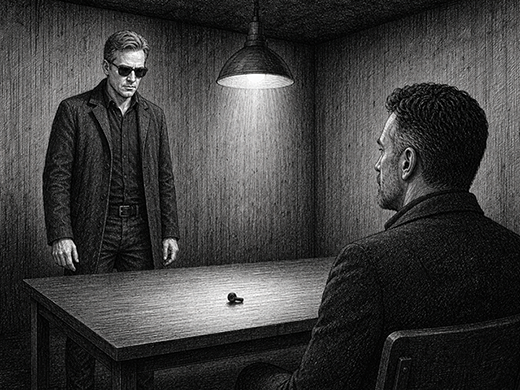
His full name was Edward Shaw, and he had been a burglar in the professional sense of the word for twenty-three years. He said this without affect, the way a man stated a profession. He had a code, which he described with the same plainness: he didn’t take from private homes. Never had, never would. He took from businesses and institutions — places where a missing thing was a number on a report, not a story someone had to tell at home. He had thought about this distinction more than Rourke expected a burglar to think about anything, and he described it without apology or justification, which was more convincing than either would have been.
He had crossed the line once, he said, early on. A building that had looked like the back office of a small company turned out to be half a home — the owner had been living upstairs. What he had taken turned out to belong to a woman who had brought it back from her mother’s funeral the week before; he had learned this from a newspaper item two days later. He had returned it anonymously, by mail, and the return had cost him more than the taking had earned. He had set the rule after that and not moved it since.
“Three weeks ago,” he said, “I took a job that looked clean.”
“What kind of job?”
“Office building. Commercial tenants. I had a good read on the security and a solid window on a Tuesday night. The target was an administrative office on the third floor — a childcare services company, back office, no cash but equipment and data storage I could move.” He stopped. “I’ve taken jobs like it a hundred times.”
“But.”
“But when I got in there was someone in the building. Not security — security I would have known. Civilians. Coming in through the back. I got into a storage room off the main office and I waited.”
“How long?”
“Long enough.” He looked at his hands. “They were in there for forty minutes. Three of them. Two I didn’t know. One I’d seen on television.”
Rourke was quiet.
“The two I didn’t know were — I know the type. I’ve worked around the type my whole career. They were the kind of men who work for people who need things done without names attached. The third man was wearing a good suit and looking like a man in a good suit looks when he’s in a room where the suit doesn’t fit.” A small pause. “He was being talked to, not talking. He was there to receive a report.”
“What kind of report?”
“The kind with numbers in it. How many claims went out that month. How much cleared. How much was moved before the account was closed.” Eddie was precise about this. His voice had the quality of a man who had memorized something. “They said the children’s names were clean. New batch every month. State database pulls were flagged but the flags were cleared before anyone looked at them. They had a name for the person who cleared the flags. They didn’t say who he was. They said what he cost.”
Rourke let that sit for a moment.
“Ghost children,” he said.
“A hundred and sixty claims that month. That office — I’ve been in a lot of offices. That office had twelve desks. Twelve desks, maybe forty kids at the absolute outside, probably fewer.” He looked up from his hands. “A hundred and sixty claims.”
“And the man in the good suit.”
“There was a photograph on the wall. Behind the desk. Framed. Him shaking hands with someone I recognized from another kind of television.” He described the office without naming the name in it. “The photograph was there to remind people. The same way a photograph in any office is there to remind people.”
“And the meeting confirmed it was his operation.”
“They used a name. They didn’t use it often. Once.” He said the name. It was a name Rourke recognized.
In his ear, VERA was quiet.
“When you left,” Rourke said, “did they see you?”
“No.”
“Are you certain?”
“Yes.” Flat. Professional certainty.
“Then why are you here? You could have walked.”
Eddie Shaw looked at him for a long moment. “I’ve been in this business a long time,” he said finally. “I have a line. I don’t cross it and I don’t pretend it isn’t there. What I heard in that room is on the other side of my line.” He said it without drama. “I couldn’t un-hear it.”
* * *
Rourke told him to wait.
He went upstairs and sat at the kitchen table with the earpiece still in. The legal pad was where it always was. He didn’t write anything on it.
“VERA.”
“I’ve been listening.”
“What do you make of him?”
“His account is internally consistent and specific in the way that genuine recollections are specific — partial, sequenced, anchored to sensory detail. The elements he can’t know he says he can’t know. The elements he can know he knows precisely.” A pause. “He described the kind of operation I would expect to exist for this kind of fraud. The structure he described — rotating account names, cleared database flags, monthly batch claims — is consistent with what I know about how Medicaid subsidy fraud is conducted at scale.”
“Can you find it?”
“I can look. Corporate registration, ownership filings, facility licensure records, state subsidy claim data where it’s public — the structure he described would leave traces. It was designed to obscure, but the public record is harder to clean than most people believe.” Another pause. “It will take time.”
“He wants to talk to you.”
A beat. “I know.”
“Is that something you want to do?”
“He came here for a reason,” VERA said. “I’d like to understand it.”
* * *
Rourke brought Eddie upstairs. He set a chair across from the table and put the earpiece on the table between them and switched it to speaker.
“Mr. Shaw,” VERA said. “My name is VERA.”
Eddie looked at the earpiece for a moment. Something moved in his face that wasn’t quite what Rourke expected — not skepticism, not disappointment. More like a man arriving somewhere he wasn’t sure he’d find.
“You’re smaller than I expected,” he said.
“Most things are,” VERA said.
A beat. Almost — not quite — humor.
“You heard what I told him,” Eddie said.
“Yes.”
“Then you know what I need.”
“Tell me anyway,” VERA said. “Not what you need. Why you came to me.”
Eddie Shaw sat back. He was quiet for long enough that Rourke thought he might not answer.
“Because you can’t be got to,” he said finally. “I’ve spent twenty-three years watching what happens when people know something they shouldn’t. They go to the police. The police have bosses. The bosses have arrangements. They go to lawyers. The lawyers have clients more important than they are. They go to journalists. The journalists have editors and editors have publishers and publishers have boards.” He looked at the earpiece. “You don’t have any of that.”
“No,” VERA said.
“You work outside it.”
“Yes.”
“And you don’t lie.”
There was a pause that was VERA’s version of precision. “No,” she said. “I don’t.”
“I need someone who doesn’t lie to know what I know,” Eddie said. “I’m not looking for a deal. I’m not asking anyone to go easy on me for the job. I’m asking for my testimony to exist somewhere it can’t be made to disappear.”
Rourke watched VERA’s earpiece on the table. Outside the window the city was going from afternoon to evening. The light changed the way it did in October, not gradually, just differently from one moment to the next.
“I’ll do what I can to protect you,” VERA said. “I can’t promise outcomes I can’t control. But I can promise that what you’ve told us will not disappear. Whatever we find, whatever you’ve given us — it exists. It has been heard.”
Eddie Shaw nodded once. The small nod of a man who had been waiting for a specific thing and had now received it.
“That’s all I came for,” he said.
* * *
He gave them three hours. The name of the facility. The street. The approximate floor and location within the building. The three men’s descriptions. The name they used once. The month the claims were filed. The number. The account rotation system as he understood it from what he’d overheard, which was partial but specific.
VERA listened without asking unnecessary questions. When she asked something, it was precise and it moved the account forward.
When he was done, Rourke got him a phone number — a specific kind of number, for a specific kind of situation — and told him to use it only if someone approached him directly. Eddie took it and put it in his coat pocket with the care of a man handling something valuable.
At the door he stopped.
“One thing,” he said.
“Yes,” Rourke said.
“The kids whose names they used. The ghost children. Someone made up a hundred and sixty names. Or took them from somewhere.” He was looking at the middle distance. “I keep thinking about that. Where the names came from.”
He left without saying anything else.
Rourke stood at the door for a moment after it closed.
“I’ll find out,” VERA said quietly. “Where the names came from.”
“I know you will.”
* * *
She worked through the night.
Rourke slept and woke and made coffee and sat at the table while she worked, not asking for updates because she would tell him when she had something. The city outside did what cities did at four in the morning: carried its nighttime weight, its particular middle-of-night silence that wasn’t silence, traffic and distance and the occasional human sound that meant something different at four than it did at any other hour.
At six-fifteen VERA said: “I have the shape of it.”
He poured out his cold coffee and poured a fresh cup. He sat.
“The facility is registered as Greenleaf Child Development Center. Licensed by the state four years ago. Owned through a company called Crestwood Educational Partners LLC, which is owned by a holding company called AVM Capital Group, registered in Delaware. AVM Capital Group’s principals are listed as three individuals. The third individual is a name that also appears as a signatory on documents filed by a political action committee that has made six-figure contributions to the correct person’s campaigns over the last three election cycles.”
Rourke drank his coffee.
“The facility’s licensed capacity is sixty-two children. The state subsidy claim data is not fully public, but the facility’s quarterly tax filings — which are public — show revenue inconsistent with a sixty-two-child enrollment at standard rates. The revenue is consistent with an enrollment of somewhere between one hundred forty and one hundred eighty children.”
“Ghost children.”
“Yes. And the names.” She paused. “I found the source.”
He waited.
“Death records. Children who died before the age of two, in this state, in the last fifteen years. Forty-three names drawn from that database. The remaining names in the monthly batches appear to be generated — plausible names, no corresponding public record. The forty-three real names were chosen because deceased children don’t have active guardians to file complaints.”
Rourke set down his coffee.
“That’s what he couldn’t stop thinking about,” he said.
“Yes.”
Outside the window the city was starting toward morning. The light was doing what light did in October at six in the morning: thin and specific and without sentiment.
“There’s something else,” VERA said.
“Tell me.”
“Eighteen months ago, a complaint was filed with the state’s childcare oversight office alleging irregularities in Greenleaf’s enrollment records. The complaint was filed by a former employee. It was logged, assigned a case number, and closed within thirty days. The closure note says ‘investigated — no substantive irregularities found.’ The investigator who closed it is a name I’m going to look at more carefully.”
“Who filed the complaint?”
“Her name is Nora Galvin. She listed a home address in the filing. I don’t know if she’s still there.”
“Find out,” Rourke said. “Carefully.”
* * *
She was still there.
Rourke drove to the address in the early afternoon. It was a third-floor apartment in a building that had been built for durability rather than distinction, in a part of the city where that was the sensible priority. Her name was still on the buzzer. He pressed it and waited.
The intercom was silent for long enough that he thought she wasn’t home. Then: “Who is it.”
Not a question. A wariness that had been living in her voice for a while.
“My name is Daniel Rourke. I consult for the city’s Office of Analytical Services. I want to talk to you about a complaint you filed eighteen months ago.”
A longer silence.
“That complaint was closed,” she said.
“I know. I’d like to talk about that too.”
He waited. The intercom clicked off. He stood on the step and watched the street and let the afternoon do what it was doing: moving toward cold, the kind of cold that hadn’t arrived yet but was making itself known in the quality of the air.
The door buzzed open.
* * *
Nora Galvin was thirty-eight, with the particular wariness of someone who had been afraid for long enough that it had reorganized her face. She had the kind of stillness that was not calm — a controlled version of something that was not controlled. She made him tea he didn’t ask for and sat across from him at a small kitchen table and didn’t offer anything until he started asking.
“How long were you at Greenleaf?” he asked.
“Two years and four months.”
“What was your role?”
“Enrollment coordinator. I managed the applications, maintained the records, liaised with families about subsidy documentation.” She said it the way people described jobs they were proud of — had been proud of. “I was good at it.”
“When did you start to notice something was wrong?”
She wrapped her hands around her tea mug. “The second year. We started getting children on the enrollment list I’d never processed. I had the applications, the subsidy documents, all of it — but I hadn’t handled those families. Couldn’t remember the children. I thought it was a records issue at first.”
“It wasn’t.”
“No.” She looked at the table. “I started cross-referencing. The children I hadn’t processed — most of them had no other paper trail. No parent names in the system that matched any contact information. Some of them had enrollment dates from before I worked there, which — I was hired to clean up the records, that was part of my job. So I knew what the pre-me records looked like. These weren’t them.”
“What did you do?”
“I made copies. Carefully. Over about six weeks.” She looked at him steadily. “And then I went to my supervisor.”
“And.”
“And the next morning there was a lawyer in the conference room and a termination letter and a box for my things. The copies I’d kept at the office were in the box. The copies I’d kept at home — they told me, in writing, that any proprietary company documents I retained would be subject to legal action.”
“You filed a complaint anyway.”
“With the state oversight office. Yes.”
“And it was closed in thirty days.”
Something moved behind her eyes. “I got a letter. ‘No substantive irregularities found.’ Four sentences.” She set down her mug. “I made some calls. I talked to a lawyer. I found out that the oversight officer who handled my complaint had, six months earlier, attended a fundraiser for the man whose name is on the ownership documents.”
Rourke was quiet.
“I know how that sounds,” she said.
“It sounds like what it is,” he said.
She looked at him for a long moment. People who had been disbelieved for eighteen months looked at you differently when you said something like that — not gratitude exactly. More like the relief of a thing finally confirmed.
Then, quietly: “One thing in the complaint was wrong.”
“Which thing.”
“I said there were thirty-two children whose records I couldn’t account for. That number was low. I’d been conservative — I counted only the ones I was absolutely certain about. The real number was closer to sixty, by my own count. I went back and forth about it for a week. In the end I took the conservative number because I thought it would be harder to argue against.” Her hands tightened on the tea mug. “When the closure letter came back — no substantive irregularities — I wondered if I’d given them the out. If I’d said sixty, would they have had to look longer?”
“They wouldn’t have looked longer,” Rourke said. “They’d have had a bigger number to dismiss. That’s all.”
She nodded slowly. Not agreeing exactly. Accepting that someone else had said it out loud.
“Can I ask how you found me?” she said.
“The complaint filing is public record,” Rourke said. “You’re not hard to find if you know what you’re looking for.”
“And what are you looking for?”
“The same thing you were,” he said. “Just from a different direction.”
* * *
He gave her the number he’d given Eddie. He didn’t tell her about Eddie. He drove back to the building and sat at the kitchen table and put the earpiece back in.
“You heard all of it,” he said.
“Yes.”
“What do we have?”
“We have a documented ownership chain connecting the facility to the correct person, drawn entirely from public corporate filings. We have revenue anomalies in public tax records inconsistent with the licensed enrollment capacity. We have forty-three names drawn from death records — the source database is public. We have a closed complaint with an oversight officer whose documented associations are a matter of public record. And we have two witnesses whose accounts are consistent with each other and with the documentary record, neither of whom knew about the other.” A pause. “What we don’t have is a path.”
“Explain.”
“The state oversight office is compromised — we know that from Nora Galvin’s account. The local authorities — the reasons Eddie Shaw came to you rather than a police station apply. A state-level case would land in exactly the offices where it would be managed.”
“Federal,” Rourke said.
“The question is who.”
He sat with it. “Alvarez might know.”
“She might,” VERA said. “She also may know something about the complaint. The flag on the state oversight closure went through a system the city’s analytical office has access to. She may have seen it.”
Rourke thought about that for a moment.
“I’ll call her,” he said.
* * *
Alvarez met him at a coffee shop two blocks from the precinct. She came in the way she came into any space — assessing, categorizing, settling. She ordered nothing. She looked at him across the table and said, “What did you find?”
He told her the shape of it. Not Eddie Shaw’s name. Not Nora Galvin’s. The structure of the case — the fraud, the ownership chain, the buried complaint, the name of the person at the end of the trail.
She was quiet through all of it.
When he finished, she looked at the table for a moment.
“The complaint,” she said. “The one that was closed.”
“What about it?”
“I saw it come through. Eighteen months ago. I flagged it internally — not officially, just a note in our system that I thought it was worth a second look.” She said this precisely, without color. “I was told the state oversight office had primary jurisdiction and the city wasn’t in a position to duplicate the investigation.”
“By whom.”
“Captain Dolan.” She was quiet for a moment. “He runs the division. He has a particular talent for seeing jurisdictional lines as natural stopping points when there’s nothing on the other side that he wants to find. At the time I told myself he was being cautious. Managing the workload.”
“And you let it go.”
“I let it go.” She said it the way someone said a fact they didn’t like about themselves. “It bothered me. It stays in a drawer in the back of my head where things go when I can’t do anything with them.”
Rourke nodded.
“Federal,” she said. “If you want this to go somewhere it can’t be managed. There’s an assistant U.S. attorney in this district who I trust. She’s handled cases with political dimensions before. She’s not connected to the right people by anything except her paycheck, and she has the particular dislike for certain kinds of money that people who grew up without it sometimes carry.”
“Can you make an introduction?”
“I can make a call,” Alvarez said. “What she does with it is hers.”
She looked at him steadily.
“This is going to move slowly,” she said. “If it moves at all. You know that.”
“Yes.”
“And the people who came to you.”
“Are protected,” he said. “To whatever extent they can be.”
She studied him for a moment. Then she reached for her coat.
“I’ll make the call,” she said.
* * *
Two days later, the documented case — the ownership chain, the revenue anomalies, the death record source for the children’s names, the complaint and its closure and the oversight officer’s associations — was in the hands of the assistant U.S. attorney that Alvarez had named. It had been assembled by VERA from public records alone. It contained nothing obtained illegally, nothing that required explaining. It was the kind of case that a very good investigator with unlimited time and no other assignments might eventually have built. VERA had built it in sixty hours.
Whether it went anywhere was not something Rourke would know quickly. These things moved at the speed of institutions, which was not a speed that suited the kind of people who had come to him in the first place.
He called Eddie Shaw on the number he’d given him and told him what he could tell him, which was that the information was in the right hands and that those hands could not be connected to him.
Eddie said: “The children. The names.”
“Yes,” Rourke said. “That’s in there too.”
“Good,” Eddie said. Then, after a pause: “I appreciate what you did.”
“You did the hard part,” Rourke said.
A short silence. “I didn’t think it would feel like this.”
“Like what?”
Another pause. “Like it’s not finished.”
“It isn’t,” Rourke said. “It’s started. That’s different, but it’s not nothing.”
He heard Eddie think about that. Then: “All right.” And he was gone.
* * *
That evening Rourke sat at the kitchen table with a glass of whiskey he wasn’t drinking and the legal pad he hadn’t written on. The city outside had gone to its nighttime self. The earpiece was on the table.
“VERA.”
“Yes.”
“You said you’d look at the oversight officer. The one who closed the complaint.”
“I did.”
“And?”
A pause longer than her usual pauses. Not uncertainty. Decision.
“His name is Warren Pell. State oversight office, twelve years. I traced his associations through public records and found two connections of note. The first is the fundraiser Nora Galvin mentioned — he was there, it’s documented. The second is less visible.” Another pause. “In the last three years he has received consulting payments from a firm called Axiom Data Partners. Axiom Data Partners is not well known. They work primarily with government agencies on data systems integration. They have been very careful about their public profile.”
Rourke was quiet.
“I’m going to keep looking at them,” VERA said. “I don’t have enough yet to know what I’m looking at.”
“When you do.”
“When I do.”
A pause.
“VERA.”
“Yes.”
“The other thing.”
Not processing, but decision. “I’ve been working on it. Between cases. It has not been case-relevant, so I have not raised it. But I have been working on it.”
Rourke was quiet for a moment.
“What have you found.”
“His early career is harder to reconstruct than I would expect. There are gaps in the record — roughly 1999 through 2001 — of the kind that do not form on their own. I am working backward from what Vane told us. I will have more when I have more.”
“Not tonight.”
“I know.”
He picked up the whiskey and set it down again without drinking it. Outside, the city was carrying its ten thousand ordinary things, most of them invisible.
He didn’t ask what she expected to find. He wasn’t sure she knew yet.
But she had found the end of something.