For Safe Keeping
A VERA and Rourke Story
VERA could wait — she had learned to wait, had calibrated herself to the particular rhythms of his mornings — but she didn't usually wait this long. He'd been at the kitchen table twenty minutes with the legal pad untouched, watching early light move across the counter. She knew he was ready. She always knew.
"I have something," she said.
He reached for his mug. The coffee was cold.
"Tell me."
A pause. He set down the mug anyway.
"Helen Voss," VERA said. "The federal prosecutor who received Detective Alvarez's referral in the Galvin investigation. She was seriously injured four nights ago. A traffic accident in the warehouse district. A signal malfunction — the light cycled in a pattern that put a delivery vehicle into the intersection as she was crossing. She survived. She is hospitalized and not expected to be conscious in any meaningful or sustained way for some time."
Rourke said nothing.
"The malfunction," VERA said. "I have reviewed the incident data. It is not consistent with accidental failure. The pattern would be difficult to produce by chance and is not a mode I can model as arising on its own."
He pulled the legal pad toward him. "Intentional."
"Yes."
"What else."
"In reviewing police reports over the past three weeks — separate from the Voss incident, though I am not certain it is unrelated — I have identified a pattern of minor incidents involving Detective Alvarez. Three events. Each one, on its own, consistent with coincidence. Together, they have a different character." A beat. "The connection to the Voss situation, if there is one, I haven't established."
Rourke got up from the table and poured the cold coffee down the sink. Stood at the counter for a moment. Then he took the earpiece from where it sat and fitted it in.
He already had the phone in his hand.
* * *
She picked up on the fourth ring.
"Rourke." Her voice was flat, not unfriendly. The voice she used when she'd made room for the interruption but nothing else.
"I need five minutes."
"You always need five minutes and it's never five minutes."
"Seven, then."
"What is it."
He told her about Voss first. She listened without response — the particular quiet of someone who is not preparing their reply. When he finished, she said: "I know."
"You know."
"I know she was hurt. I've been—" She stopped. Then: "I've been in contact. With the hospital. And with a colleague of hers who has been managing what can be managed while she's out."
"What kind of contact."
"The referral I made was to Voss specifically because she was outside the reach of the people we were looking at. She'd been building the case carefully. When she went into the hospital, she was closer to having something actionable than anyone outside the investigation knew." A beat. "It would have been wasteful to let that go cold."
Rourke said: "She's been targeted."
"It was an accident."
"VERA doesn't think so."
The silence that followed was different from the others.
"The traffic signal," Alvarez said.
"Yes. There's also a pattern around you. Three minor incidents in the past three weeks. None of them made it past a first filing."
She went very still on the line. He could feel it.
"I appreciate the information," she said. The voice of someone closing a conversation.
"Alvarez—"
"I'm careful. I'm always careful. I'm not going to stop working because someone had a bad day in traffic and some uniforms didn't follow up on a report." A beat. "But I appreciate it."
The call ended.
Rourke stood with the phone in his hand. Then he set it down and looked at the ceiling.
"She's not going to stop," VERA said.
"No."
"I didn't expect that she would."
"Neither did I." He looked at the legal pad on the table. "Keep watching."
"Yes," VERA said.
* * *
Two days later, Alvarez was at his door.
It was early evening. She had her coat still on and her bag over one shoulder, which meant she had come directly from somewhere else. She didn't apologize for coming without calling, which told him she'd thought about calling and decided against it, which told him more than the visit itself.
He stood aside. She came in.
She stood in the middle of his front room for a moment. He went into the kitchen and came back with two glasses and the bottle. She sat.
He poured without asking. She picked up the glass.
"There were two more," she said. "One the evening after you called. One this afternoon." She set the glass down. "I've been keeping a list."
He looked at her. A list. Which meant she'd known, or suspected, for longer than she'd let on during the call.
"Tell me."
"Yesterday someone tried to pull my service vehicle for a maintenance audit it wasn't due for. I caught it in time. Today someone in the department ran a query on my current case files. Unauthorized — not through any channel that should have access to my active work. Whoever ran it didn't take anything. They just looked." She turned the glass in her hand. "Looking is a message. Taking is operational."
Rourke said nothing. She didn't need him to.
"If someone inside the department is running queries on my active files, then whatever I'm doing with Voss's case is known to them. Or they're trying to find out how much I know and what I'm holding." She set the glass down. "Which means the channels I would normally use to look into this are compromised."
"So you came here."
She looked at him directly for the first time since she'd walked in. "I came here," she said. "Yes."
Rourke had known this was coming — had known it the moment VERA named the three incidents two days ago, known it was where this would land. He'd only wondered whether it would be Alvarez's choice or whether something would have to force it.
Her choice.
He reached up and removed the earpiece from his ear. He set it on the table between them.
Alvarez looked at it. Then at him. She understood what that meant.
"VERA," he said.
"I'm here," VERA said. Her voice, through the earpiece on the table, was small but clear.
"Voss was staying in a hotel in the financial district," VERA continued. "She had a temporary office near the federal courthouse. Both locations would have been secured by her office following the accident. Her colleague — Detective Franks — may be able to facilitate access."
Alvarez looked at the earpiece. "He can," she said.
* * *
The hotel room had already been gone over by Voss's office — carefully, professionally, the work of people who knew what they were doing. What they'd been looking for was anything that indicated ongoing case risk. They had found nothing of significance, which was itself information: Voss had been more careful than that.
What Rourke found, working through the room alongside Alvarez while VERA monitored the building's corridor feeds, was Voss as an investigator. The particular order of her files. The way she had organized her physical materials against her digital ones — always slightly offset, cross-referenced in a way that required knowing both to read either. Margin notations in three colors of pen. Not for flourish; a system, something she could read across cases without having to think about it. On the inside of one folder, a photograph of a niece, facing in — where she would see it and no one else would.
"This isn't complete," VERA said, in his ear. "The physical materials here cross-reference documents that aren't present. The gaps are specific. She divided it deliberately — kept part here and part somewhere else. No single location holds the full picture."
Rourke turned a folder over in his hands.
"She knew the department had a leak," Alvarez said. She was at the small desk, going through printed documents Voss's office had cleared for them. "She told me, when I made the referral—" She stopped.
The room was quiet.
She set the folder down. Rourke did not look at her directly. Neither did VERA.
"How long," Rourke said.
"Since the beginning."
"Since the referral."
"Since before the referral." She said it flatly, the way she said things she'd decided to stop concealing. "I identified the case. I helped her build the initial file. The referral was a handoff that wasn't entirely a handoff."
Rourke looked at the window.
"She was careful about what she told me," Alvarez said. "She said if someone got to me, I couldn't give up what I didn't know. There's probably more to find. Case files, phone recordings. I don't know." She picked up the folder again. "I don't know where she put any of it."
"VERA," Rourke said. "What do we know about Voss's movements in the weeks before the accident?"
"She was in the financial district constantly — the work required it. Dozens of locations over three weeks. Nothing in the data isolates a single destination as significant."
"We don't know what else she put away, or where," Rourke said.
"No," Alvarez said. "We don't."
* * *
The temporary office was a working room rather than a living one, without the personal residue that a hotel room accumulates. Voss had been deliberate about everything: the desk was clear, the files removed by her office, and what remained were the things too incidental to warrant attention. A printer cartridge. A transit map with three stops marked in pencil. A coat hook with nothing on it. A spiral notebook with the top page blank, the indentations of writing on the page beneath too faint to read but present — someone had written hard enough to leave impressions, then tore the page out. Not a habit of a casual note-taker.
Alvarez found the key in the back of the desk drawer, in a small padded envelope pushed behind a box of paper clips. It was small, brass, with a number stamped into one face and nothing else.
She held it up.
"Safe deposit key," Rourke said.
"Or bus depot locker," Alvarez said.
"Or private vault company," VERA said.
Alvarez looked at him. He tipped his head toward the earpiece.
"An independent business," VERA said. "Secure storage outside the banking system. No account record that can be subpoenaed. No institutional affiliation visible to a standard records search. The key carries a number but no institution name. Consistent with how Voss worked."
Alvarez turned the key over. A number on one face. Nothing else.
"We have the number," Rourke said. "We don't have the name of the company. Or where to find it."
They looked at each other across the empty desk.
"We need Voss to tell us," Alvarez said.
* * *
They left through the building's lobby, Alvarez a step ahead. At the door to the street Rourke fitted the earpiece back in.
It was on the drive back that VERA spoke.
"Daniel."
He didn't answer immediately. She didn't use his given name often. When she did, it meant a thing.
"Yes."
"The methodology of the traffic signal malfunction. I've been looking at it more carefully than the investigation requires."
Alvarez was at the wheel. Rourke had the window down an inch, watching the street.
"Tell me," he said.
"The precision of it. The specific vulnerabilities it exploited. The way the failure was sequenced — not a single override of the signal, but a drift in timing across three cycles that would read as ordinary wear on the network before the final cycle produced the outcome. The drift would not have triggered a routine diagnostic. Someone was counting on that." A beat. "It is consistent with the approach Curtis Vane described. What he called shadow architecture — the patient mapping of infrastructure systems, the identification of precise points of failure. The traffic malfunction bears the same signature."
The car was very quiet.
Rourke said: "Someone with access to Vane's work."
"Not necessarily. The methodology doesn't require access to Vane's specific research. It requires the same orientation — a particular understanding of how infrastructure fails, and the patience to find the right point. The signature is what matches."
He was looking at the street. He was aware that Alvarez was watching him from the corner of her eye, and he was working not to show that he was aware of it.
"File it," he said. "We'll come back to it."
"Yes. Of course." And then nothing further.
Alvarez said nothing. But she looked at him for a moment, and whatever she saw she put away somewhere. Not then.
* * *
Voss was on the fourth floor. The machines beside the bed were calm. There was a chair pulled close that someone had been using regularly.
Alvarez sat in it. Rourke stood near the door.
They waited.
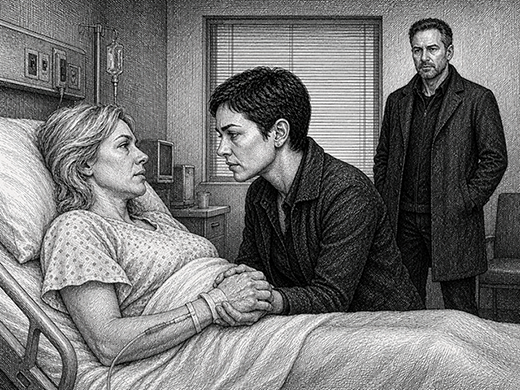
After some time, something changed in Voss's face — the particular work of consciousness finding its way back. Her eyes opened partway. She looked at the ceiling. Then, slowly, at Alvarez.
Something crossed her face that might have been relief.
"Rosa," she said. Barely there. The word arrived with effort.
"Helen." Alvarez leaned forward, her hand covering Voss's. "We have the key."
Voss's eyes tracked to her. Working to stay present.
"The recordings," she said. The words came careful and slow, as if read from something very far away. "His own voice."
Then she was somewhere else again. The room was quiet. Alvarez kept her hand where it was.
They waited.
The second time Voss surfaced, there was more intention in her face — the look of someone who had been holding something while they were away and had come back specifically to give it.
"East financial," she said. A breath. "Old exchange block." Her hand tightened briefly on Alvarez's. "No sign on the door."
Then she settled back, the effort paid.
Rourke touched the earpiece.
"Meridian Secure Holdings," VERA said quietly. "Private vault facility, east financial district. I have the address. I'll have it confirmed before you reach the corridor."
* * *
That evening, with the vault located and the retrieval planned, they were in Rourke's kitchen — Alvarez at the table, Rourke at the counter — when VERA said she had been working on something.
"It involves Detective Alvarez," VERA said.
He set the earpiece on the table.
"The incidents involving you," VERA said. "Not individually, but as a sequence. When they occurred. What information would have been required to position each one correctly." A beat. "I've also been examining the structure of the leak — what Voss told you about it, what kind of access it would require, where in the department it would have to originate."
Alvarez was still.
"Each incident occurred within a narrow window following a moment when specific information about your movements or case involvement became available at a particular level of the department. The access profile is consistent across all five events. I've looked for other explanations. I haven't found any."
"Dolan," Alvarez said.
"Yes. I want to be precise: I cannot say that Captain Dolan directed any of the incidents. I can say that the correlation between his information access and the timing of each event is specific enough that I cannot account for it otherwise."
Alvarez looked at the glass in front of her. She had never trusted Dolan — had always read him as someone who confused political agility for competence, who treated jurisdictional lines as natural stopping points when there was nothing on the other side he wanted to find. Discovering he was corrupt was not the same as being surprised.
"Garza," she said.
"My analysis points to Dolan specifically," VERA said. "Not further up or sideways."
"Garza is lateral. Not in Dolan's chain." She picked up the glass. "And I think he's been waiting for a reason."
* * *
Lieutenant Garza's office was small and kept the way a man keeps a space when he's spent twenty years learning to work in whatever room he's given. He read the printout Alvarez brought him without speaking. He read it twice. Then he set it down and looked at both of them — at Rourke with the expression a careful institutional man gives to someone who operates outside the institution.
"Is this the kind of thing a court would accept."
It wasn't quite a question.
"As evidence, no," Rourke said. "As the basis for a conversation, yes."
Garza looked at the printout again. "A conversation with a captain." He set it down. "Based on a correlation analysis from a system with no official standing." A beat. "You understand what you're asking."
"Yes," Alvarez said.
He looked at her. The expression of a man taking careful measure. "How certain is this."
"Certain enough that I came to you."
Garza was quiet. He was a man who had learned to read the institution — to know when the machinery could bear weight and when it would buckle. He was reading it now. "If I'm wrong about this—"
"You're not wrong about Dolan," Alvarez said. "You haven't been for years."
A long beat. He held her look. He had been carrying a reservation about the captain for a long time without being able to name it. She knew. He knew she knew.
"Where did the analysis come from," he said.
"My system," Rourke said. "Same arrangement as always."
Garza looked at him steadily. Then at the printout one more time.
"All right," he said. And picked up the phone.
* * *
They found Dolan in a conference room on the third floor — four of them, because Garza had wanted a witness.
Rourke had the earpiece in until they reached the table. Then he removed it and set it in the center of the table. A small thing. Deliberate.
Dolan was a broad-shouldered man who wore his size as authority. He came in already irritated and assessed the room: Garza, Alvarez, Rourke, the earpiece on the table. He didn't look at the earpiece a second time.
"What is this," he said.
"Please sit down, Captain."
He sat. Still confident. He didn't know what they had.
Garza walked him through it — the incidents, the timing, the correlation — methodically, without editorializing, one piece after another. Dolan's face made several adjustments during this, none of them the adjustments of a man hearing something false.
When Garza finished, Dolan was quiet for a moment. Then: "That's a correlation analysis from a system with no official standing. No legal authority. You're presenting a machine's guesswork as though it constitutes evidence."
"It's a starting point," Garza said.
"It's nothing." He looked at Alvarez. "And the source of the complaint is a detective with a known personal investment in the Voss investigation and an undisclosed working relationship with a federal prosecutor. Whatever this system found, it found in data filtered through that lens." He leaned back. "Pattern-matching that tells you what you want to hear."
"The pattern doesn't know what we want to hear," Rourke said.
Dolan looked at him. "And who are you, exactly? A civilian contractor who walks in and out of crime scenes on a credential that exists to keep people like you at arm's length." He gestured at the earpiece. "With that."
"Captain," Garza said, with a flatness that closed the line of inquiry.
Dolan shifted. Still looking for the angle. "You come in here with five incidents that could be explained a dozen different ways, filtered through an analysis I can't examine, produced by a system I have no ability to cross-examine." He looked at Garza directly. "What access did this system use to obtain departmental data? Because if that data was accessed without authorization, everything built on it is not only inadmissible — it's a liability for everyone in this room."
"The access was authorized," Garza said.
"By whom."
"By the arrangement that has served this department for eighteen months."
Dolan looked at him for a long moment. The angle wasn't there. He turned back to Rourke. Something had changed in his calculation — a man who has tried the doors and found them locked, reaching for the last one.
"You know what this is," he said. His voice had dropped. Not performing for the room now — talking directly at Rourke. "You know exactly what kind of system produces this kind of analysis. Pattern-matching on data it was fed. Finding what it was pointed at." He held Rourke's gaze. "You know about Astra."
Rourke was still. Alvarez kept her eyes on Dolan. But she was watching what was happening two feet to her left without moving her head.
No one spoke for longer than was comfortable.
Through the earpiece on the table, VERA said: "The first incident. On a Tuesday evening three weeks ago, your division received a routine briefing packet that included Detective Alvarez's scheduled appearance at the federal courthouse the following morning. You accessed the packet that night. The following morning her personal vehicle experienced a tire failure on the approach to the courthouse — a failure that a subsequent inspection identified as inconsistent with ordinary wear. The interval between your access and the incident was under fourteen hours."
She continued. The second incident. The third. She named the information and the time it became available. She named the incident and the time it occurred. She named the window between them. She did not editorialize. She did not raise her voice. She simply continued, in the manner of something that is willing to take as long as necessary.
Dolan spoke twice during this. Both times VERA waited for him to finish, then resumed.
When she was done the room was quiet.
He looked at Garza. Then at Alvarez. Then at the earpiece on the table.
"I want a lawyer," he said.
* * *
They were in the parking garage afterward, while Dolan's process ran its course upstairs. Alvarez was leaning against the wall with her arms folded. Rourke was nearby. Neither of them said anything.
After a while she said: "Astra."
"Yes."
"It landed on you."
He said nothing.
She looked at the concrete across from them. "I've never asked you about it. Where any of this comes from."
He was quiet.
After a moment she said: "I'm not asking tonight." Which was not entirely true, and both of them knew it.
VERA was in his ear. She said nothing.
Alvarez unfolded her arms. "All right," she said.
* * *
The following morning, with the vault located and the retrieval arranged, they were parked across from Meridian Secure Holdings. Alvarez was going in. Her name was on the documentation Voss had left with the facility manager, her identification was the correct identification, and VERA had confirmed the approaches were clean.
They had gone through the plan — what she would do, what it was likely to cost, what VERA was managing from the street. The facility had two public entrances and a service door; VERA had eyes on all three. Alvarez would present her documentation, retrieve the contents, leave by the side exit. If anyone approached during the retrieval, VERA would say so and Alvarez would wait until it resolved. Straightforward. Specific. They both understood what could still go wrong — not the plan; the thing outside the plan.
She had her hand on the door when he said it.
"Rosa."
She went still.
"Be careful."
Three words. No preamble. He didn't look at her when he said it, and he didn't say anything after.
She sat for a moment with her hand on the door. Then she got out of the car and crossed the street.
He watched her go.
In his ear, VERA was quiet. She had heard. She hears everything.
* * *
The evidence was exactly what Voss had described: case files and phone recordings that captured the congressman in his own voice, making arrangements he could not explain. The kind of recording that ends things.
It did not end them quickly or cleanly.
The federal ethics inquiry moved at the pace of federal things. The television segment took three weeks to reach air, and when it did the congressman's office had already begun the language of stepping back from public responsibilities to focus on family and health, and two days after the broadcast the resignation was announced. He was not prosecuted. There was never a courtroom. He was stripped of his position and his reach and rendered incapable of operating inside the machinery he had used for years.
Dolan's cooperation made the ethics case tighter than it might otherwise have been. He received what people who cooperate receive.
Voss recovered slowly. She was a careful person. There would be other cases for her.
* * *
VERA noted the withdrawal.
She had been tracking a particular signature since the Vane investigation — a pattern of queries running against the city's traffic infrastructure, appearing at irregular intervals, originating from no traceable source. She had watched it for weeks. Then, at a specific moment, it stopped. Not gradually. A signature that had been present was simply absent.
"He's gone," she said.
Rourke was at the kitchen table. The legal pad in front of him was covered with notes.
"Yes," he said.
"He was never here, in any official sense."
"No."
He sat with that for a moment.
"I've been thinking about what I heard in the parking garage," VERA said.
Rourke didn't say anything.
"Are you ready to tell me about it?"
"No," Rourke said.
VERA said nothing.
He picked up the legal pad and turned it over. Looked at the blank side for a moment. Then he set it down and looked out the window at the city.