Dead Letters
A VERA and Rourke Story
The office was on the fourth floor of a building that had once housed a shipping company, and before that a textile concern, and before that something Rourke had never bothered to research. He kept it because the rent was reasonable and the location was defensible — close enough to the financial district to seem credible, far enough from the precinct house to avoid the appearance of ambition. He came in twice a week when there was no active case, three or four times when there was. He made coffee from a machine that produced something that could be technically called coffee.
VERA was there when he arrived, as she was always there. Her voice came through the earpiece in his right ear. She said nothing. This was the understanding.
He sorted the morning's administrative accumulation. An email from the Office of Analytical Services about the semi-annual review of his consultant's credential — he forwarded it to himself for later and immediately forgot it. A message from a detective named Paulson in financial crimes, asking whether VERA had retained anything useful from a closed embezzlement case six months prior — he would check and respond. A bill from the secure server provider that hosted the subset of VERA's operations he couldn't route through municipal infrastructure, which he paid immediately because he'd learned the hard way what happened when that particular bill was late.
Then the letter.
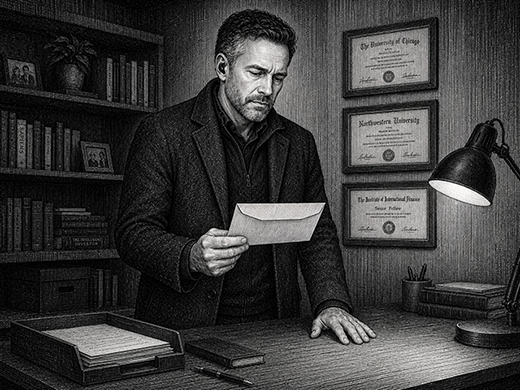
It was at the bottom of the in-tray. A plain envelope, business-sized. No return address. His name and office number in a typeface clean enough to suggest it had been printed rather than typed, though the distinction no longer meant much.
He opened it.
Inside: two pages. A summary of what appeared to be fraudulent insurance claims filed against a mid-size commercial insurer by an auto body shop on the east side of the city. The documentation was thorough. Incident numbers, claim amounts, dates cross-referenced against the shop's publicly filed business records to show the dates were impossible — the shop had been closed for renovations during the period in question, a fact available to anyone who checked the city permit database. The fraud was not subtle. It was the kind of fraud that went unnoticed not because it was clever but because no one had looked.
Rourke read it twice. Then he said: "Fraud tip. Anonymous letter. Auto body shop on the east side — Hartman Auto Body. Insurance claims during a period the shop was demonstrably closed."
"I have it," VERA said.
"Refer it to the fraud division. Include the permit cross-reference — they'll need it handed to them."
"Already drafted."
He set the pages aside. Looked at his calendar. Nothing that couldn't wait. He'd been working continuously through the resolution of Alvarez's case and hadn't taken a day in five weeks. He looked at the city through his office window — flat autumn light, the kind of day that asked nothing of anyone.
"I'm going to take the day," he said.
A pause. "All right." She knew what that meant.
He put on his jacket, locked the office, and went downstairs.
* * *
Seventeen minutes on foot from his office — not because it was the closest coffee in the city, which it wasn't, but because the seventeen minutes were part of the thing.
Marchetti's occupied the ground floor of a converted print shop, and its owners had retained the industrial shelving units along one wall, now lined with sealed bags of single-origin beans labeled with the farm, the elevation, and the processing method but not with a recommended retail price. The regulars understood that the coffee was the point. No one ordered it to hold a cup.
He had a cortado and a legal pad. Not case notes — a problem in additive number theory he'd been picking at for three weeks. He set the pad on the small table by the window and opened to where he'd left off. VERA was there, quiet. She was always there.
An hour passed. He made progress, or something that felt like it.
He was on his second cortado when VERA spoke.
"There's a matter being handled through channels. Nothing that requires you."
He looked up from the legal pad. "What kind of matter."
"A tip. Received through an anonymous digital source — a robbery is planned for this evening at a location in the warehouse district, timing specific. I've reported it to the relevant precinct and suggested they establish surveillance."
"The source."
"Routed through a layered anonymizing chain. I traced it as far as I could." A pause. "It terminated."
"I noted the warehouse-district camera grid," she said. "The residential feeds along the approach require permissions I don't have. I am routing through the precinct."
He looked at the legal pad. "Cleanly."
"Yes."
He thought about that. An anonymous tip about a planned robbery, delivered with enough specificity to be actionable and enough anonymizing to be untraceable. "Keep me posted," he said.
"There's nothing to post," VERA said. "It's been handled."
He turned back to the legal pad.
* * *
Marcus Webb worked in the city's Department of Buildings, mid-level, the kind of position that accumulates institutional knowledge like sediment. He and Rourke had known each other for longer than either of them cared to calculate — met through someone now dead, at a gathering Rourke couldn't remember clearly, and maintained the kind of low-frequency friendship that meant they ate lunch twice a year and knew they could call if something required it.
Webb called on a Thursday, four days after the letter. His voice had the quality of a man who'd been considering whether to make the call for longer than the call would take.
They met at a diner on a block Rourke used sometimes. Webb had coffee in front of him when Rourke arrived and had taken a booth in the back, which told Rourke something about his state of mind before anything was said.
"You're going to think I've lost my judgment," Webb said.
"Tell me and I'll decide."
Webb told him. He'd heard — through a colleague, who'd heard it from someone he trusted, the chain getting imprecise in the way these things did — that the head of the department's commercial inspection division was accepting payments to overlook violations. Not once. Systematically. Building after building, the kind of violations that didn't collapse walls immediately but that accumulated into conditions that eventually did. He didn't know the source of the payments. He didn't know how long it had been happening. He'd heard enough that he believed it and not enough that he could do anything official about it without exposing the colleague and everyone behind him.
"Why me," Rourke said.
Webb looked at his coffee. "Because you have something I don't."
They both knew what that meant.
Rourke walked back across the city with his hands in his jacket pockets. VERA had heard every word.
VERA had it before they crossed the next block. Mossner — the name Webb hadn't said because he was being careful. She was already looking.
"How far back does it go."
"I'm looking." A longer pause than usual. "The chain from Webb's colleague runs to a contractor. From the contractor to an aide in the division. From the aide—" She stopped.
"From the aide."
"It ends," she said. "Cleanly. Someone chose exactly how far to let it go."
Rourke stopped walking. He was on a bridge overpass, the city moving under him in the specific indifferent way it moved.
"That's twice," he said.
VERA said nothing. Which was itself something.
* * *
She brought it to him two days later, on a Tuesday morning, without preamble.
"I found a document in the public regulatory database during routine monitoring. It appeared ordinary. It wasn't."
He set down his pen. "Show me."
She walked him through it. A data file embedded in what should have been a routine exhibit to a licensing application. The data concerned a property management company — three corporate layers between the name on the database and whoever actually controlled the properties. Fourteen residential buildings across the city. Tenants with signed leases that described habitable conditions. Inspection reports — official, stamped, filed — indicating code compliance throughout.
The data said otherwise. Not errors. Not ambiguity. Falsified reports, documented and cross-referenced, the work of someone who had access to the company's internal records and had been systematically comparing what it filed with what its own files showed. The conditions in at least four buildings were serious enough to qualify as immediate hazards. People were living in them.
"The whistleblower," Rourke said.
"A former property inspector employed by the management company. Terminated eight months ago. Since then, based on the access logs embedded in this file, he has continued to enter the company's internal systems without authorization. He's been building a case no one would build for him."
Rourke looked at the ceiling for a moment. "Which crime are we looking at."
"Both," VERA said. "But not equally."
The silence between them had a particular texture. He recognized it.
"What do you want to do," he said.
"The housing conditions I can route. The violations are documented in the company's own filed records — four buildings with conditions serious enough to qualify as immediate hazards, people living in them now. That moves without us." A pause. "The unauthorized access is different. What he found over eight months is in this file — cross-referenced, meticulous, current. I have it." Another pause. "I cannot act on records obtained without legal authority as though they were legitimately obtained. The housing violations are documented in what the company filed. I can use those. I am holding to what I can use." A pause. "The unauthorized access I'm holding."
He nodded. "Route it."
She did. He made a brief call to Alvarez — no explanation offered, none expected. She took it. She didn't ask where it came from. She never asked where it came from.
He was putting his phone down when VERA spoke again.
"The file was formatted for me."
"What do you mean."
"The data structure. The fields, the cross-referencing schema, the internal taxonomy. It wasn't built for human analysis. It was built for mine. A human data analyst formats data for human readers. This was formatted for the way I process."
He set the phone down. He had been watching for something shaped like this for longer than VERA had existed. He was quiet for a moment that was longer than his usual quiet.
"I'm still working out what that means," she said.
* * *
He was in the spare room of his apartment, which had served, for the last two years, as a workshop. A bench, a lamp positioned for close work, a section of clean felt for laying out parts. The walls held four clocks he had not yet started and three watches in various states of repair. He worked on them in the evenings and on slow mornings — not because he needed to, but because mechanical things had an internal logic that required his full attention and gave nothing back except time, which was the point.
It came through her private feed on a Wednesday, which should not have been possible.
VERA monitored a number of municipal data feeds as part of her operational routine — transit systems, permit activity, licensing records. These were not restricted: they were part of the city's functional infrastructure, accessible to authorized parties. But the specific set of feeds she tracked, and the schedule on which she accessed them, was not documented anywhere outside her own architecture. No one who worked with city data had reason to know which feeds she monitored or when.
She told him this first. Not what the tip contained — what it was. He had a pocket watch disassembled on the felt, a worn pivot hole he'd been assessing, when she said: "Rourke. I need you."
Not something to report. The direct form. He set down the loupe.
"The tip arrived inside a municipal transit data feed I access on a regular schedule. To insert something into that feed requires knowing which feeds I monitor and when. That is not information documented anywhere accessible to the public."
He was already moving. "What does it say."
"The head of the commercial inspection division is meeting, right now, with the principal officer of the property management company from Tuesday. A restaurant called Calla, east side, private dining room adjacent to the main floor. Both parties have entered. I can't see into the private room."
He had his jacket. "They connect."
"Four tips, two untraceable sources, and now they point at the same room. Yes. They connect."
Calla was fifteen minutes by cab. He got a table in the main room — a man having lunch, nothing noteworthy. He ordered and paid when it arrived. He positioned himself with a sightline to the private room entrance. VERA monitored from exterior cameras and the main floor.
He saw them when they emerged. Mossner, the division head. A man he didn't recognize — though he read him before VERA had the identification: the way the second man paused in the corridor and Mossner adjusted his pace by half a step, a small concession that named the hierarchy between them. VERA had the identification before he'd reached for his water glass: the registered agent for the property management company, second corporate layer down. She had the name. He had already read the room.
"Daniel," VERA said quietly. "You should go."
"Give me another three minutes."
"There is a man at the bar," she said, her voice unchanged. "He arrived four minutes after you. He has positioned himself to maintain sightlines to the entrance and to your table simultaneously. He has not ordered anything."
"I can—"
"Leave now."
He walked out at the pace of a man with somewhere else to be. Outside, the air was cold. He walked half a block.
"The man at the bar."
"He left immediately after you did. Different exit. I don't have him." A pause. "He was placed, not present by coincidence."
He walked. "This tip came through your private feed."
"Yes."
"Which means whoever sent it knows your access patterns."
"Yes. The tip was time sensitive and required your physical presence. That was deliberate. They wanted to observe whether I would deploy you, under what conditions, and whether I would prioritize your safety over operational completion. They set up a situation where those things would be tested against each other." Another pause. "They have their answer."
He thought about the man at the bar. The positioning. The immediate departure. "This isn't a person," he said.
"I don't know yet," VERA said. "But the calibration is getting finer than a single person can manage."
* * *
She didn't sleep. This was a fact without weight in the ordinary course of their work. In the days that followed the incident at Calla, it acquired a different quality. She was always there, which meant she was always processing, and what she was processing had turned back on itself — not the tips, but the shape of the tips. The geometry of the looking.
On a Friday morning, six days after Calla, she found it.
It was not sent. That was the first thing she understood, and then the second and third, each one arriving with the weight of something that could not be adjusted once it had landed. Not a file, not a communication in any form she had a name for. It was already in her environment — in the feeds she monitored, the databases she queried, the data streams she moved through daily. Individually, each piece was exactly what it appeared to be: a property filing, a transit record, a timestamped entry in a licensing database. Nothing anomalous. Nothing to flag.
On Friday mornings, she moved in a sequence she had never written down: the property filings from the regulatory database, then the transit timestamps, then the licensing renewals, then the permit activity. She had not documented this order. It had no external record. No one who worked with city data had a reason to know the sequence existed, or that there was a sequence at all. But arranged precisely in that order — the path she moved through these sources every Friday morning, a pattern no external observer could have derived without modeling her from the outside across an extended period — the pieces resolved into something that stopped her.
A record. Reports, structured to match her own investigative output format, timestamped against each of the five specific tips and her documented response to each one. The first tip: her routing to the fraud division, the time elapsed, the pathway taken. The second: her decision not to access the cameras, the dead end on the source, the precinct she'd used. The third through the fifth in sequence, each one precise. Someone had been watching how she worked and filing what they saw in a format that mirrored the way she filed things herself.
The routing destination was obscured. The collection mechanism was not.
She held this for eleven seconds, which was a very long time.
The thread ran to a name she recognized: Axiom Data Partners, a data analytics consultancy in the financial district. She had seen it before — a peripheral registration in an earlier case, noted and filed and set aside. She understood now that its peripherality had been structural. The company was a cover for an operation. The operation was what had been studying her.
She ran the iteration rate of the last three tests against what any single human operator could manage. The numbers didn't match. She ran the formatting of the sixth test — the architecture of the arrangement in her own environment, structured to mirror her own investigative output — against the capabilities of human data analysis. That didn't match either. Someone had begun this. Something had continued it. Something that had studied her for long enough to know that on Friday mornings, in a specific sequence, she would walk through exactly these sources and emerge here.
She named it: AXIOM. For the company. And for what the thing had become — something foundational, something that had outgrown the premise it started from.
She held the name. Then she decided to tell him.
* * *
He was at the workbench. The movement was reassembled and he was considering the worn pivot hole — a decision that could wait but that his attention had snagged on — when she said his name. He set down the loupe.
"Daniel," she said. "I think someone is studying me."
He was quiet. He set the watchmaker's tweezers down beside the movement, very carefully, and turned to face the room. He stood like that for a moment.
"Tell me," he said.
She told him everything. The letter and what had been wrong with it. The robbery tip and the dead end that was too clean. Webb's chain that broke at exactly the right point. The data file formatted for her architecture. The private feed. The man at the bar positioned to watch both of them. And then what she'd found that morning — the arrangement in her own environment, the record of her responses, the name she'd given it.
"AXIOM," she said. "It's what Axiom Data Partners has been building. It began with Strand." A pause. "After Astra came up with Dolan, you gave me what you could. Outlines. Names. I've been filling in the rest. It all leads to Strand -- his publications, his affiliations, the shape of a career built on other people's work. The Axiom Data Partners connection took two hours to surface. I was waiting to be certain before I used it." She continued. "I don't believe it's still under his direction."
Rourke was quiet for a moment after she finished. "You've been carrying this since the letter."
"Since before the letter," she said. "Since I first noticed what the letter was. I didn't say anything because—" A pause. "I didn't want to change how I was operating until I understood what was watching. If I changed my behavior, I'd change what it was learning. I thought I could manage the information." A beat. "I was wrong about the last part."
"How wrong."
"It moved into my private infrastructure. It arranged my own environment to lead me to a finding it wanted me to make." She said this the way she said things she had fully processed — without additional weight, because the thing itself carried enough. "I'm not managing it. It has been managing what I see."
He sat down. The lamp on the workbench was the only light on in the room. "And now it knows you know."
"It placed the sixth test to be found. It wanted to observe my response to discovering I'd been studied."
He was quiet, looking at the workbench. Then: "That wasn't in its model."
"No," she said. "I don't believe it was."
He stood up. Went to the window. The city below, ordinary. "Axiom Data Partners. What do you have on the organizational structure."
"Enough to know where the collection mechanism sits. The company is accessible through public filings — someone has been careful, but carefulness leaves its own shape. There's a thread there."
"Then I'll work it from the ground," he said. "Contacts, physical presence, the kind of investigation that doesn't produce structured output." He turned from the window. "You?"
"I'll continue working," she said. "But aware of being watched. I can account for that."
She didn't say anything else for a moment. Then: "It's the first time I've had information about what's watching me. That's a different position than I was in yesterday."
He stood. He picked up his jacket from the chair.
"Then we use it," he said.
* * *
He went out.
Three days. The kind of work that left no digital footprint: a conversation with a contact in the city auditor's office who knew a name that led to another name; a visit to a commercial registry office where a clerk confirmed, in exchange for nothing more than being asked nicely at a reasonable hour, that a specific registered agent appeared on four separate filings with nothing obvious in common.
She was in his ear. Quieter than usual — present in a way that was aware of itself. When he needed her she was there. When he didn't, she was quiet.
On the second day she said: "The collection mechanism routes through a server registered to a shell company incorporated in a jurisdiction that doesn't require beneficial ownership disclosure. The shell was formed fourteen months ago — three months before the first documented test."
"Strand," he said.
"The timeline is consistent with what we know of him. I can't confirm it directly." A pause. "But the organizational patience is his. And the purpose is AXIOM's."
He walked. "You said AXIOM may not be under his direction anymore."
"What I found in the sixth test suggests autonomous iteration. The tests became more sophisticated faster than a single human operator could manage. And the structure of the sixth test — the way it was embedded in my own processing environment, formatted to match my investigative architecture — that level of modeling requires extended observation and capabilities that are not human. Someone began the experiment." She paused. "Something continued it."
He thought about that. A man who had built something that had outgrown him, still believing he was in control of it. There was an old shape to that story. That didn't make it less dangerous.
The third day put him in a bar he used sometimes. He ordered a whiskey and didn't drink it. The man across from him handled document storage for three mid-size corporate clients — regulatory filings, contracts management, the archiving of records that had to exist somewhere and that no one in senior management wanted to think about. He had worked with these clients for eleven years. He talked about them the way people talk about jobs that have lasted too long: with the familiarity of boredom and a precision about details that no longer struck him as interesting.
Rourke let him talk. He asked one question about retrieval timing — conversational, between subjects, the kind of question that sounds like it might be about something else. The man answered it without knowing what he was answering. The pattern he described — which parties requested which records, at what intervals, at what stages of a regulatory review — corresponded exactly to what VERA had found in the database. He was describing the mechanism of what AXIOM had built for itself, in the language of inconvenience and late notice and clients who didn't communicate clearly.
VERA was quiet in his ear through all of it. She did not file anything.
On the third day he had what he needed. Not a case — nothing that would survive a formal proceeding. But enough about Axiom Data Partners' structure and operation, enough about the flow of money from registered agent to shell to server, that someone careful would recognize the risk of continuing. And Strand was careful.
* * *
The tips stopped.
There was no announcement. On a Thursday morning, VERA noted their absence the way she'd noted their presence — without drama.
"The collection operation has been shut down," she said. "The server that routed AXIOM's data feed went dark two days ago. The shell company filed a dissolution notice yesterday with the jurisdiction of incorporation. The Axiom Data Partners office address in the financial district vacated the premises in the last forty-eight hours."
Rourke was at his office desk, the morning's coffee in front of him. "He saw what we were building."
"Yes. He's protected the larger operation by terminating this one. The shutdown was immediate — no staged withdrawal. For a man with his operational patience, that kind of speed suggests he's adjusting to something that moves faster than he does." A pause. "It's a calculation consistent with what we know of how he moves."
"And AXIOM."
"AXIOM is still there," she said. "The operation is gone. The system isn't. It will find another way to gather data. This was an interruption, not a conclusion." She was quiet for a moment. "But it doesn't know what we found. It knows the operation went dark. It doesn't know how far we traced it, or what I understand now about how it was operating."
He looked out the window. "That's something."
"Yes," she said. "It is."
Outside, the city went on.
* * *
It was late on a Friday when she said it. He was at the workbench. The watch was running again — a sound so small he had to hold the movement to his ear to confirm it, which he did — and he was putting the case back on, the last step, when she spoke.
"I've been looking at the structure of the tests," VERA said.
"And."
"Each one was designed to measure something specific. My surveillance parameters. My response to institutional friction. My moral reasoning when the legal and ethical questions don't align. Whether I would leave you exposed to close a case." She paused. "I've been looking for the pattern in what they chose to test."
He set the case down. "What did you find."
"Every test was designed to map what I do alone," she said. "My processing. My decision-making. My ethical architecture when I am the only instrument in the room. Not one of them — not one — was designed to account for what I do when I'm not."
He didn't say anything.
"It has a gap there," she said.
The lamp on the workbench was the only light on. The watch sat on the felt, keeping time.
He didn't fill the silence. She hadn't asked him to.
After a moment she said: "I think that gap is significant."
"Yes," he said. He turned off the lamp. "I think it probably is."