The Longest Goodbye
A VERA and Rourke Story
The watch on the felt pad had stopped in 1987, which was not a coincidence. The man who had owned it had wound it precisely and consistently for forty years before, and then one day had not. The mainspring was intact. The escape wheel was intact. Something in the gear train had seized for a reason Rourke had not yet found, and he had been looking for three evenings.
He set down the loupe and rolled his neck.
"She's coming up the front steps."
He didn't answer. He already knew — VERA had told him two minutes ago that Alvarez had parked on the street, which was earlier than he had expected, though he couldn't have said when he'd started expecting it. Ruben Alvarez had been missing for two days. The department was working it. VERA had been monitoring since the report came in, quietly, the way she monitored all active investigations, accumulating without interfering. Rourke had known and had not called, because calling would have required him to know what to say.
He got up and went to the cabinet.
He took out the bottle and two glasses and carried them to the low table in front of the sofa. He looked at them for a moment, then went to answer the door.
* * *
She was in plain clothes. Dark jacket, dark trousers, practical footwear that could cover ground. She had not dressed for a visit — or rather she had dressed the way she always dressed, which meant she had come here directly and without ceremony. Her hands were at her sides.
"Rourke."
"Come in."
He stepped back. She came through the door and he closed it behind her. He walked her toward the living room with the particular unhurried courtesy of a man who has decided not to make anything into a moment.
She sat without asking. He sat in the chair across from her and poured two fingers into each glass and set hers in front of her. She picked it up and drank it in one go.
He set his down untouched.
"The department—" she started.
"I know."
She stopped. A muscle moved in her jaw.
He wanted to say something useful and could not locate anything useful to say. She had not come here for condolences. She had not come here to be told it would be all right, which he could not have told her honestly. She had come here because she was locked out of an investigation she needed to be inside, because the people running it were not wrong to lock her out and were also not going to find her father, and because there was nowhere else to go. He understood all of this and could not find the door into it.
After the silence became awkward, he reached up and took the earpiece from his ear and set it on the table between them.
"Detective Alvarez." VERA's voice came from the small device on the table, unhurried, carrying across the room without effort. "I've reconstructed your father's route."
* * *
Then Alvarez said: "Show me."
Rourke reached for his phone, opened the interface, and set it on the table where she could see. A street map appeared — the blocks around Ruben's building, a route marked in clean lines.
"This is the route as you described it to the department," VERA said. "North on Calder, east on Nineteenth to the park, south through to the fountain, back west on Twentieth. Approximately two miles. Forty to fifty minutes at a moderate pace."
Alvarez studied it with the stillness of someone who had been in many rooms where maps were shown. "That's right."
"I've marked the camera locations with coverage along that route." Small indicators appeared — intersections, storefronts. "Seven points where archived footage would place him on any given Tuesday or Thursday morning."
"The department pulled that footage."
"For the day he disappeared. I'm interested in the weeks before."
Alvarez looked up from the phone.
"During the canvass," VERA continued, "a shopkeeper on Calder near Twenty-Second was interviewed. He recognized your father from the photograph. He said he'd seen him several times recently, always on foot, heading east."
Alvarez said nothing.
"At Twenty-Second and Calder, the route you described turns north toward the park. East takes you into the commercial district." A beat. "The detective noted the response and moved on. It was one comment in twelve interviews."
"He should have followed up."
"He was conducting a canvass — not the time for a follow-up, but someone should have, yes."
Something moved in Alvarez's expression — not quite a flinch. She was seeing a mistake in the investigation, a gap that would not have been a gap if she had been allowed to work it. But there was something else: her father had altered his habits, gone somewhere she didn't know about. A part of his life she hadn't known was there.
"There are four camera locations east of that intersection," VERA said. "A pharmacy on Monroe. A traffic installation at Twenty-Second — that one would require access through official channels. A restaurant supply company with exterior coverage. And a parking lot on that same corner with a security camera. None of them are on the department's radar because none of them are on the described route."
Rourke picked up his phone. "I'll have the footage by morning."
"I can—" Alvarez started.
"No," Rourke said. Not unkindly.
She knew that. She set her jaw and didn't argue, and he could see what it cost her.
"Go home," he said. "I'll call you when I have something."
She sat for a moment longer. Then she stood and he walked her to the door.
At the threshold she stopped without turning. "If he—" She didn't finish it.
"I'll call you," Rourke said.
She left.
He stood at the closed door for a moment. Then he went back to the living room, picked up the earpiece from the table and settled it into his ear.
"The pharmacy opens at seven," VERA said. "The restaurant supply company opens at eight and will require some persuasion. Meridian Parking runs the lot — their operations office is on Fulton Street. That's where you'd find someone who can pull the footage."
"I'll manage."
"I know."
He looked at the untouched glass on the table. He picked it up and drank it and set it back down.
* * *
The pharmacy opened at seven. Rourke was there at six fifty-eight.
The manager was a compact man in his fifties who arrived with his keys already out and did not appear surprised to find someone waiting. Rourke showed his credentials and explained what he needed — exterior camera, archived footage, the last eight weeks of Tuesday and Thursday mornings. The manager looked at him for a moment before deciding that a missing person was sufficient reason to be cooperative before his first coffee.
"How far back?" the manager asked.
"Eight weeks."
The transfer took four minutes. The manager watched it happen with the focused blankness of someone who had decided to be helpful and was waiting for helpful to be over. He pocketed the drive, thanked the manager, and left.
* * *
The Meridian Parking operations office was on Fulton Street, in the kind of space that had been built for retail and repurposed for everything else — low ceiling, fluorescent light, a counter with a man behind it who had the expression of someone accustomed to resolving inconveniences.
Rourke explained what he needed. The man found a number in a binder, made a call, spoke briefly in the tone of someone who made this particular request often enough to have a system for it, and set the phone down.
"Come back in an hour. The footage is archived offsite."
Rourke said he would and went to the restaurant supply company.
* * *
The restaurant supply company on Monroe opened at eight. The man behind the counter had the build of someone who had spent twenty years moving commercial refrigeration units and had developed views about people who arrived without appointments.
"Footage," he said. Not a question.
"Exterior camera, facing the street. Eight weeks, Tuesday and Thursday mornings."
"You police?"
"I'm working with the police on a missing person case." True in all the ways that mattered.
The man looked at him for a moment. Then he looked at the camera mounted above the door frame, as though registering its existence for the first time.
"You got a card?"
Rourke gave him one. The man turned it over, read both sides, set it on the counter.
"Give me ten minutes," he said.
Rourke gave him ten minutes.
* * *
He picked up the drive from Meridian Parking Operations on his way back to the apartment. He was back before noon. As he plugged the drives in, VERA said, “I’ll process the Tuesday footage first.”
He set the phone on the desk and poured water and stood at the window while she worked. The city was fully awake by now, the street below moving at its ordinary pace. He drank the water and did not think about anything in particular, which was a skill he had spent years developing.
"There," VERA said.
He turned back to the phone. On the screen: a street-level view from the restaurant supply camera, timestamp reading seven weeks prior. Ruben Alvarez — the photograph he had memorized — walking east on Monroe. Past the camera's edge, out of frame.
“He turned east,” Rourke said.
"Yes. I have him at the same point on six Tuesdays and one Thursday over the eight weeks before his disappearance." A brief pause — the kind that meant she was confirming rather than hesitating. "He goes to a restaurant. Half a block east. Same table."
"Every time."
"Every time. And he's not alone."
* * *
The man came back in three of the six Tuesday sequences and the single Thursday. VERA had a composite — blurred at distance, clearer in the Monroe camera footage than in the others, clearest in a frame where he turned briefly toward the street for a reason that was his and not the camera's.
"I have enough," she said.
The cross-reference took twenty-two minutes. He appeared in the background of a Keystone Construction project announcement in the city business journal, three years prior — a groundbreaking ceremony, a line of men in hard hats with shovels, the way those things were done. He was not named in the caption. She confirmed the match.
"Frank Novak," VERA said. "Senior accounts manager at Keystone Construction. Fourteen years with the firm. He lives on Brentmore, in the Colton building. I have an address."
Rourke wrote it down. "What do we have on Keystone?"
"A company that size accumulates complaints. Suppliers, subcontractors, permit disputes. All cleared. There was one more significant matter — a building collapse during construction of a project on Alderman Street, three years ago. No fatalities. Keystone was investigated and cleared of any wrongdoing."
"Cleared," Rourke said.
"The ruling found structural failure in the foundation formwork, consistent with the approved materials grade. The investigation was concluded." A pause. "Keystone cooperated fully."
"Keystone," he said.
"Yes."
"Why is a retired man having regular lunch meetings with a senior accountant at Keystone Construction?"
Neither of them had an answer.
* * *
Ruben Alvarez lived in a two-bedroom apartment on the fifth floor of a building that was older than most of the neighborhood around it — the kind of building that had been built to last and had simply proceeded to do so without making a point of it. The super let Rourke in without enthusiasm and without obstruction.
The apartment was the apartment of a man who had lived alone for some years and had made his peace with it. Neat without being sterile. Books on two shelves, organized in a way that suggested they were read rather than displayed. A small kitchen with the kind of efficiency that comes from cooking for one for long enough.
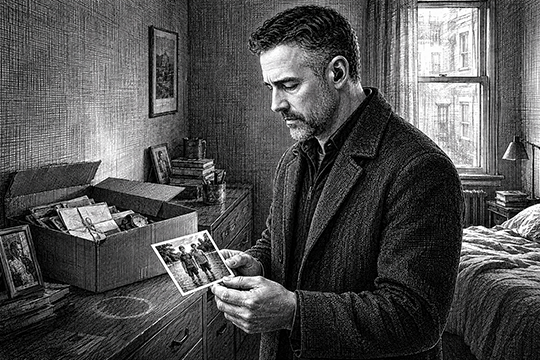
On the dresser in the bedroom, among the ordinary accumulation of a lived life, was a cardboard box. It had been recently moved — the faint dust ring around it on the dresser surface was larger than the box itself. Rourke lifted the lid.
Photographs. Letters in rubber-banded bundles. A watch that had stopped. Small objects whose significance was entirely private.
He found the photograph near the top. Two men, younger, standing knee-deep in a river — a real river, wide and cold-looking, with the particular light of the American mountain west in summer. They were grinning with the ease of men who were happy and knew it. On the back, in handwriting he didn't recognize: Montana.
He turned it over again and looked at the two faces. Something about the second man snagged his attention before his reasoning caught up with it. He photographed the picture with his phone and sent it to VERA without saying anything.
A moment passed.
"Yes," VERA said quietly. "That's the man from the footage."
Rourke stood there for a moment with the photograph in his hand. The box. The moved dust ring. The watch that had stopped.
"He found this," Rourke said. "Recently. Went through the box and found this."
"Yes."
"And called the man in the photograph."
"That would be consistent with what we know."
He set the photograph back carefully and closed the lid. A man had gone through a box of old things and found a picture of a friend from forty-five years ago and called him because it was summer and the picture was of a river and the past called to him.
That was the whole reason.
* * *
The Colton building was six stories of pre-war brick on Brentmore, with a lobby that smelled of floor wax and a directory that hadn't been updated in several years. Novak was listed for 7C. The elevator was working.
Rourke knocked. He waited. He knocked again.
The door moved.
He looked at it for a moment. It had not latched — the latch was fully extended, the striker plate simply not catching it. Either the lock had been forced at some point and poorly repaired, or someone had left in a hurry without pulling the door fully closed.
"Rourke," VERA said.
He didn't answer. He pushed the door open with one finger and went in.
The apartment was a single man's space, similar to Ruben's in its economy and different in its character. Where Ruben's apartment felt inhabited, this one felt occupied — the furniture was functional, the surfaces clear in a way that suggested deliberate clearance rather than orderliness. An accountant's apartment. Everything in its column.
On the mantle: his own copy of the fishing photograph. Same river, same summer, the same two men. Frank Novak had kept his copy too.
The desk was in the second room. On it: a laptop, closed. A legal pad with notes in a small, precise hand — the habit of someone who thought better when writing than when typing. A cup of pens. And a small stack of opened mail, weighted by a smooth stone, the kind that comes out of a cold river and fits the palm — perhaps a memento from a Montana trout stream.
Rourke went through the stack. A utility bill from Consolidated Electric. A building association notice announcing the annual members meeting. A dental reminder. A statement from a cloud storage company — six dollars and forty-nine cents a month, a service called VaultKeep. A subscription renewal for a financial journal.
He photographed it all with his phone.
"Got it," VERA said.
He set the mail back under the stone, the way he had found it.
He pulled the door shut behind him.
* * *
Keystone Construction occupied the top two floors of a building in the development corridor, in offices that communicated the right amount of ambition without overcommitting to it. The receptionist told Rourke that Maddox was in a meeting. Rourke said he was happy to wait. He waited for eleven minutes before the receptionist told him that Maddox would see him now.
The office was a corner room with a view of two streets. Maddox stood behind his desk rather than sitting. He was a man in his late fifties, compact, with the particular stillness of someone who was always the calmest person in any room he arranged to be in. He did not come around the desk to shake hands. He gestured toward the chair in front of it.
Rourke sat.
"You're the investigator," Maddox said. Not a question and not an introduction.
"Background research. I'm doing a retrospective on the Alderman Street collapse for a liability consultancy. Nothing adversarial — they want a complete picture before the statute window closes."
"The collapse was ruled accidental. Structural failure in the foundation formwork, consistent with the grade of materials approved for the project. Our engineers cooperated fully with the city investigation."
The answer was smooth. Not rehearsed in the nervous sense — practiced in the sense of a man who had given it many times and had long since stopped listening to himself give it. He was not defending himself. He was producing a response that had the shape of an explanation without being one.
"Of course," Rourke said. "I'm mostly interested in the contractor relationships at the time. Subcontractors, materials suppliers. For the timeline."
Maddox gave him what he asked for, and what he gave him was nothing — names that would produce paper trails that would produce nothing, the kind of cooperation that was entirely forthcoming and entirely empty. Rourke wrote things in his notebook.
Then, near the end, as he was closing the notebook, he said: "One of your long-term staff — Frank Novak. He would have been involved in the project financials at the time. I'd like to talk to him if possible."
The half-beat was small. A man recalibrating. He recovered in under a second, and the recovery was good — better than most people managed. But VERA, in the earpiece, had caught it. Rourke felt the slight pressure of her attention, the particular quality of her focus when something had been confirmed.
"Frank's on extended leave," Maddox said. "Personal matter. I can pass along a message."
"That would be helpful," Rourke said. "Thank you for your time."
He shook the hand that was finally offered, nodded to the receptionist on the way out, and took the stairs rather than the elevator.
In the stairwell, VERA said: "The collapse answer was prepared. Novak's name was not."
"No," Rourke said. "It wasn't."
"He's hiding something."
"Yes. He is."
* * *
Three days passed.
VERA continued. She mapped Keystone's corporate structure, its contract history, its subsidiary relationships and the shell companies visible at the edges of its public filings. She monitored the channels she was authorized to monitor. She built a picture of a company that was extensively and professionally hidden, the kind of organization that had been shielded for long enough that the shielding had become structural.
What she did not find was Ruben Alvarez.
Rourke ran down the names Maddox had given him, which produced the nothing they had been designed to produce. He spoke to building inspectors. He pulled permits. He went back to the camera locations on Ruben's route and spoke to the people who worked behind those frontages, asking questions he had already asked, hoping for the detail that had been forgotten the first time. He returned to the Colton building twice — knocked on the door of 7C, no answer, stood in the corridor for a moment. He called the number he had for Novak and reached a recording that did not include Novak's name.
Alvarez called on the fourth day. She had been calling every day and he had been answering every day and every day the call had been brief because there was nothing to say that he hadn't already said. But on the fourth day something was different in the quality of the silence on her end when he finished speaking. The fury that had been her fuel since the beginning was thinning. What was under it was older and harder and quieter.
"I keep thinking about the photograph," she said. "The one in the box."
He didn't say anything.
"I didn't know he still had photographs from back then. From before my mother. I didn't know he thought about those years." A pause. "I never asked."
"You'll be able to ask him," Rourke said.
She was quiet for a moment. "You don't know that."
"No," he said. "I don't."
The call ended. He sat for a while in the apartment. In the workshop, on the felt pad, the stopped watch waited with the patience of something that had never expected anything to be different.
* * *
On the sixth day, VERA said: "There's a John Doe."
Rourke was in the kitchen. He set down his coffee.
"City infrastructure crew doing a smart grid survey. They were inventorying legacy utility spaces in the Garfield corridor — decommissioned telecom vaults, the old analog network. One of them hadn't been opened in years. They opened it."
"Condition?"
"The report doesn't estimate how long. The vault is sealed and climate-stable, which would affect the estimate anyway. Male, mid-fifties, no identification — wallet, phone, anything with a name on it, all removed. No prints in the system. No DNA match."
"You think it's Novak.
"Because Frank Novak hasn't been back to his apartment in six days. His mail is collecting in the box." A brief pause. "And the John Doe is consistent with his build."
Rourke was quiet.
"I asked the morgue for the intake photographs," VERA said. "I have the fishing photo. The faces are consistent. The man in the vault is the right age, the right build, and the right coloring—"
"It's him," Rourke said.
"Very probably."
He stood at the counter for a moment. The coffee was going cold. He thought about Frank Novak, who had been a cautionary tale, who had made a thousand small choices and then one morning had answered the telephone.
"VERA."
"Yes."
"If someone killed Frank to close a liability—"
"Then Ruben Alvarez may also be a liability," she said. "I've been thinking about that."
"How much time do we have?"
"I don't know. If he is still alive, it suggests that whoever is holding him hasn't decided yet. But that can change quickly."
Rourke was already moving.
* * *
He called her from the street. "Marchetti's. Seventeen minutes."
She was already there when he arrived. She had found a table in the back corner with a clear sightline to the door, which was where she always sat, and there was a cup in front of her that she hadn't touched. She looked up when he came in and read his face before he sat down.
"Tell me," she said.
He sat. He told her. The John Doe in the Garfield telecom vault. His inability to locate Frank Novak. VERA's comparison of the intake photographs. He gave her the facts in the order he had them and did not editorialize and did not slow down to cushion anything.
When he finished she looked at her cup for a moment.
"Ruben doesn't know anything," she said. "He called an old friend. That's all he did."
"I know."
"They took him because of my name. Because of what my name means to people in that world."
"Yes."
She was quiet. Around them Marchetti's carried on — the grinder, a conversation near the window, the ordinary sounds of the middle of the day. She sat in the middle of it with the stillness of someone using everything they had to remain still.
"How long?" she asked.
"VERA doesn't know. She thinks they may be still deciding."
Alvarez looked up. "Then we need to find him before they decide."
* * *
VERA had been working Keystone's property holdings since the Maddox interview. Eleven assets in various states — active construction sites, properties held for development, two parcels with legal complications that had kept them off the active roster for years. She had been watching all of them as a matter of course. When Frank's body was found in the Garfield corridor, one of them moved to the top of the list.
A commercial office building in the downtown Garfield district, twelve stories, built in the 1970s. Keystone had acquired it as part of a planned mixed-use development that had stalled at the permitting stage three years prior. Officially vacant. No active utility accounts, no listed tenants, no permits for any work. A dormant asset on a balance sheet — and within walking distance of the telecom vault where Frank was found.
"Proximity alone isn't enough," VERA said. "But twenty minutes ago, a man entered through the loading bay on the east side. He used a key. He was inside for nine minutes and came back out. He has not left the area."
"A vacant building. No tenants. No utilities. And someone with a key."
"Yes. I think he went in to check on Ruben. A man who checks suggests a man who is close to a decision. I think the clock just shortened."
"Can you watch every exit?"
"There are four registered entrances. I have camera coverage on three of them. The fourth is a service access on the north face — the camera that would cover it was vandalized eight months ago and hasn't been replaced."
"Three out of four."
"Three out of four," she agreed. "Rourke, I have the architectural records for the building. The loading bay entrance opens into a central corridor on the ground floor. The south stairwell is directly off that corridor — it's the closest route up from where you'd enter. The north stairwell is on the face I can't watch."
"South stairs from the loading bay."
"Yes. And Rourke — if there is a utility corridor, if the building connects to adjacent infrastructure at the basement level, I won't see it. I can only watch what I can see."
"I know." He was already working out the route. "Call me if he moves."
"Yes." A beat. "Be careful."
He was already moving.
* * *
He called Alvarez from two blocks out.
"Garfield commercial district, an abandoned office building at Morrow and Calder. Loading bay entrance, east side. An unknown individual entered approximately twenty minutes ago using a key. The building is officially vacant — no tenants, no utilities, no active permits."
"How certain?"
"Certain enough."
A pause that was not hesitation but decision. "I need to make a call."
"I know. Make it."
He stayed on the exterior while she did what she needed to do. He could see the loading bay from where he stood — the steel door, the key lock, the security camera that VERA had confirmed was disconnected from any active feed. He watched the north face and thought about the entrance he couldn't see.
Twenty-two minutes later, he heard the first siren.
Alvarez had gone to Garza. She had sat across from him and told him everything — Rourke, VERA, the six days of parallel investigation, the fishing photograph, Frank Novak in the telecom vault, the building on Morrow and her belief that her father was being held inside. Garza had listened to all of it without interrupting. Then he had picked up his phone.
They came with what the situation warranted. Four patrol units. A tactical team. Two detectives from the missing persons division who had been working the official case and who stepped aside without ceremony when they understood what was happening. The department moving for one of their own, which had a particular quality — not faster, exactly, but more complete. Every piece of it committed.
Alvarez went in with the tactical team. She had the badge and she had the authority and she had been waiting six days for something to do with the rage, and this was it.
Rourke stayed at the perimeter. VERA was in his ear, watching the three entrances she could watch, saying nothing because there was nothing to say.
Then: "The north face."
"What?"
"Movement. I can't see it but I can see the street beyond it — there's a figure moving east on Garfield that wasn't there thirty seconds ago. Single individual, moving quickly."
Rourke was already running. He reached the corner in time to see a man in a grey jacket turning north on Mercer, unhurried now, walking the way someone walks when they have decided that running would be the wrong choice. He was carrying a bag. He did not look back.
By the time Rourke reached Mercer, the man had turned again and was gone.
He stood on the empty pavement and breathed.
VERA said: "Alvarez has him."
"Say that again."
"Twelfth floor. Ruben Alvarez. He's alive."
Rourke stood on the pavement in the afternoon sun and said nothing for a long moment. Around him the city carried on, indifferent to the fact that a man who had found a photograph in a box and felt the weight of the years was coming home.
"The other man," VERA said. "I lost him at Mercer and Ninth. I'm sorry."
"It's all right."
"It isn't, quite."
"No," he said. "But it will do for now."
* * *
The man in the grey jacket hadn't turned up in any system VERA could reach, but then she had never gotten a clear image of him — in every camera that had caught him, he had been at the edge of the frame, angled away, or moving through the gap between coverage zones as though he knew precisely where those gaps were. No fingerprints recovered from the building. No DNA. Nothing left behind that carried a name. She spent two hours searching after the building was cleared and came back empty, which she had expected. And Ruben, when Alvarez had asked him, could not help: the man had kept his face covered throughout his captivity. He had been careful from the beginning. He remained entirely anonymous — not by accident, but by the practice of a career.
He had planned the exit before he took the job, known exactly where he would go and through what space, and been gone before the tactical team reached the upper floors. The utility corridor connecting the building to the adjacent structure at basement level appeared in no current architectural filing. He had known about it. He had always been going to leave that way.
Rourke found Alvarez on the street outside the building. Ruben was nearby, sitting on the back step of an ambulance, a blanket around his shoulders and a paramedic taking his blood pressure. He was talking — the particular animated speech of a man who has been quiet for too long — and Alvarez stood close enough to hear him and far enough away to watch the street at the same time.
Rourke stopped beside her.
"Maddox is going to walk," he said.
A pause. "I know." Her voice was different from everything it had been for six days — lower, quieter, the rage burned out of it. What was left was something more durable. "Not forever. But for now."
"VERA's working it."
"I know that too." She didn't look away from Ruben. "We know it was him. We know he authorized this. We just can't prove it yet."
"Yet," Rourke said.
She nodded once. Then: "Thank you, Rourke."
He didn't say anything immediately. There was nothing that the moment required him to say.
"Go be with your father," he said.
She went.
* * *
He was back at the apartment by nine. He sat in the chair in the living room where Alvarez had sat six days before and looked at the low table and the place where the two glasses had been.
"Rourke."
"Yes."
"The cloud storage account. VaultKeep, six forty-nine a month. I've been thinking about it since you found the statement."
He sat up slightly. "Go on."
"Frank Novak was an accountant for fourteen years at a company that was maintaining systematic fraud across its financials. He was not the architect of the fraud — the structure predates his seniority at the firm. But he was the person who knew what the real numbers were."
"He knew what it meant," Rourke said.
"Yes. And a man who knew that, and who had been quietly frightened since a building collapsed, and who had perhaps been keeping a private record somewhere of what the numbers actually said—"
She stopped. She didn't finish it. She didn't need to.
"Can you access the account?" he asked.
"Not without authorization. But Alvarez can get it."
* * *
It took Alvarez three days to get the warrant. She applied for it through channels, attached everything they had — Frank Novak's tentative identification as the John Doe, his employment at Keystone, the building on Morrow and its connection to Ruben's abduction, the statement from his desk with the account number. A judge who understood what she was asking and why signed it on the third day.
The account contained 847 files.
Frank Novak had been keeping records for eighteen months. Not a whistleblower's dossier — there was no cover letter, no explanatory note, no address to a future reader. Just the numbers, set down in spreadsheets with the precision of a man who could not stop being an accountant. Materials costs on one side, official invoice amounts on the other, the difference logged without comment. Inspector payments, dated and itemized, the amounts and the names recorded in cells that were just cells — no drama, no accusation, only the plain record of what had happened. A ledger of everything the official books had been made to say instead of the truth.
Eighteen months of it. Going back to approximately the point at which the Alderman Street collapse was ruled accidental. Frank had been there, had known the numbers behind the failure, and had said nothing. But the ruling was what he could not absorb. The official version was going to stand. The books were going to say one thing and the truth was going to say another, and he could not let that be the only record that existed.
VERA went through all 847 files in forty minutes.
"He connects Maddox personally to the materials substitution on fourteen projects," she said. "Approval signatures, all traceable. The inspector payments route through three shell companies and then to direct disbursements that Maddox authorized individually. And there is a payments record for a private consulting engagement beginning six weeks before Ruben's disappearance." A pause. "The consulting firm is not named. The payment amounts are there."
Rourke understood. "The man who murdered Frank Novak and took Ruben Alvarez."
"That would be consistent with the amounts and the timing. A prosecutor will make the argument."
He sat with that for a moment. Fourteen years at a company that had asked him to look away, and Frank had looked away, right up until he couldn't. And then he had done the only honest thing left available to him, which was to keep the numbers right somewhere, even if it was only for himself, even if it was only in a private account that no one was ever supposed to find.
He hadn't known he was building a case. He had just been an accountant.
* * *
The investigation took four months. A federal prosecutor, working from the files VERA had catalogued and Alvarez had delivered, built a case against Keystone Construction and against Maddox personally. The other two partners cooperated; they had always looked away and now they looked directly and said everything they knew, which was less than they claimed but more than enough. A forensic accountant confirmed Frank Novak's parallel records were accurate — cross-checked against supplier invoices and municipal payment records, the numbers held at every point.
Maddox was arrested on a Tuesday morning. The city business journal ran the story below the fold. He was charged with fraud, bribery of public officials, and — on the strength of the consulting payments record and the circumstantial architecture Frank's books had built — conspiracy in connection with Frank Novak's death and Ruben Alvarez's abduction.
The man in the grey jacket was never identified. The warrant that went out for him was comprehensive and produced nothing, which was not a surprise to anyone who had seen him turn the corner on Mercer and Ninth and simply become part of the city. That thread remained open. Some threads did.
Keystone's active contracts were suspended pending the investigation. The building on Morrow was seized as a material asset. The development project that had stalled at the permitting stage three years prior would not resume.
Garza officially cleared Alvarez of any impropriety in connection with her parallel investigation, on the grounds that she had not conducted an investigation but had engaged private contractors who had provided information that was then used through proper channels. VERA was not city property — she had no standing in the department's infrastructure, and the city's access to her work had come through a private consulting arrangement with Rourke, not through any departmental channel. The distinction was technical. It held.
* * *
Three weeks after Maddox's arrest, on a Tuesday morning, Ruben Alvarez took his constitutional.
Rosa had tried, gently, to suggest he might want to vary the timing. He had listened to her with the patience of a man who had always listened to her and then said that the walk was the walk and that if he changed it now then the people who had taken him would have changed something permanently, and he was not willing to give them that.
She had not argued with him. She had stood on the sidewalk outside his building at seven-fifteen in the morning and watched him head north on Calder, a compact man in his late sixties in a good coat, walking at a deliberate pace, and she had stayed there until he turned the corner and was out of sight.
Then she had called Rourke.
Not to report anything. Not to ask for anything. When he answered, she said: "He's walking."
"Good," Rourke said.
A pause.
"I keep thinking about what he said," she told him. "About not giving them the walk. He's right, but I'm going to worry every Tuesday anyway."
"I know."
"VERA will keep an eye out."
It was not a question.
"She will," Rourke said. And then, because it was true and because the morning seemed to want it: "Rosa."
She was quiet for a moment. "I know," she said. "Thank you, Rourke."
She ended the call. She stood on the sidewalk for another moment in the morning sun, looking at the corner where her father had turned and disappeared, before she went to get her car.