The Tenant
A VERA and Rourke Story
He walked north along the river path three miles every Wednesday. The dog walkers were out, and the joggers had the determined expression of people who were certain this was good for them. He was not certain of anything but that walking helped him think.
VERA was in his ear. She said nothing.
His phone rang at the first bridge crossing. The caller ID read Cal.
He answered.
"Danny."
Cal Merritt was the only person who still called him that. Rourke had tried to correct it for three years in graduate school and then given up, and forty years of tolerance had converted the irritant into something else.
"Cal."
"You're picking up. That's a good sign. Are you at home?"
"No."
"It's seven in the morning."
"I know."
A pause. In the background: the sound of an office—HVAC, keyboard, the compressed quiet of a building that was already at work. Cal was an early riser. He had been an early riser in graduate school too, which Rourke had always attributed to ambition and now suspected was just metabolism.
"How are things," Cal said. Not a question—a bridge to something else.
"Fine. You?"
"Good. Good, mostly. Actually—" He stopped. "That's why I'm calling."
Rourke said nothing. He let Cal find his own way to it.
"I have a situation. With a client. There's something wrong and I can't work out what it is, and I know that is maybe not your usual kind of thing — I mean, it’s not the forensic AI stuff—”
“Investigative Intelligence.”
A pause. “Right. That. Is that still—”
“What kind of problem?”
"A software problem. Behavior that doesn't make sense. The kind of thing that can make for very unhappy clients, which—" He made a sound that was not quite a laugh. "I don't have a lot of clients, Danny. I don't need any unhappy ones."
VERA's voice came through the earpiece, quiet and close as she always was: He has twelve active client relationships. The firm was founded nine years ago.
Background check. She had run it before the second sentence.
Rourke said, "You want to meet."
"If you have time."
"I have time. This morning?"
"This morning." The relief in Cal's voice was more than the situation seemed to warrant, which meant the situation was worse than what he had described. "I can come to you."
"There's a coffee roaster on Clement," Rourke said. "I'll send you the address."
"I'll find it."
"Eleven o'clock."
"Eleven," Cal said. "Thank you, Danny."
"Don't thank me yet."
* * *
He walked the next half mile without speaking. The path curved east at the boat launch and then south again along the water. The city moved around him in its ordinary morning way. He moved through it and waited for VERA.
"An investment manager," VERA said. "His clients are individuals. High net-worth, not institutional. He would be running proprietary tools—something he built himself, or built with a small team."
"Go on."
"He described it as a software problem. But he didn't say the software was broken. He said it was wrong."
Rourke kept walking. "You noticed that."
"It's a different word. Broken means it has stopped functioning. Wrong means it has continued functioning and produced an outcome that should not have happened." A pause. "An investment system that is wrong is more concerning than one that is broken."
"He called me," Rourke said.
"Which means he has already tried the people he would normally try, and they couldn't help him, or he couldn't tell them. If it's serious enough, he may not have wanted anyone inside his industry to know it's happening."
The boat launch gave way to the park path, and the park path gave way to the street grid where the neighborhood was waking up over its coffee and its phones. He put his hands in his coat pockets.
"He's worried about his clients," he said.
"He made a joke of it. Men don't usually bother joking about things that don't matter." She paused. "He's been carrying this long enough that he was relieved when you picked up."
"You got that from his tone of voice?"
"I got that from the way he stopped himself the first time and then didn't stop the second time. And from the relief."
He said nothing.
"He's your friend," she said.
"Forty years," he said.
They walked the rest of the way in silence.
* * *
The roaster on Clement was not a café in any welcoming sense of the word. It was a working space that happened to have a counter, and the counter happened to have an espresso machine, and the people who knew about it were the kind of people who did not require ambiance to appreciate good coffee. Three tables, industrial metal chairs, bare concrete walls, and the deep smell of roasting that Rourke had liked well enough to become a regular. The woman behind the counter knew his order. She did not take it unless he gave it.
Cal was at the door at five past eleven in a coat that belonged to a different kind of place—good wool, properly fitted, the coat of a man whose professional success required it of him. He surveyed the room, looking vaguely out of place. Then he saw Rourke at the back table and his expression simplified into something more direct.
They shook hands. Cal was heavier than he had been at CMU, but not in the way of men who had let themselves go—in the way of men who had arrived at their correct weight after a long time at the wrong one. His hair was mostly white. His eyes were the same as they had always been: quick and slightly worried, as if expecting something else to happen at any moment.
Rourke gestured toward the counter. "Get something."
Cal got a double espresso and brought it back and sat down. He looked at the cup for a moment.
"You look the same," he said.
"I don't."
"No. But the effect is the same." He wrapped his hands around the cup. "I should have called you sooner."
"Tell me what it is."
It came out in pieces, not quite in order—the client who had first flagged an anomaly, the trades that had underperformed in a way the model should not have produced, the audit Cal had run and the discrepancy he couldn't explain, the second client who had raised a similar concern two weeks later. He had pulled the code apart three times. The code was correct. The system was doing what the code said. The code was saying the wrong thing.
"When did the anomalies start?" Rourke said.
Cal thought. "Seven, eight weeks ago. Maybe a bit before. It was hard to know at first whether I was looking at noise or something real."
"You're certain now."
"I'm certain it's not noise. I've audited the code three times. I know what the code does. The code is correct." He looked at the cup. "The answers are wrong. I can't find the gap."
"Tell me about the anomalies. What does wrong look like in an investment model?"
Cal told him. He told him with the precision of a man who had been working the problem alone and was grateful to explain it to someone who was listening properly. The positions that should have performed. The signal the model had produced. The gap between what the model said and what a model built that way should say. He had looked at the inputs and looked at the architecture and could not find the point of failure. The machine was intact. The answer was wrong.
Rourke listened until Cal ran out of words to describe his problem.
He reached into his jacket and took out a card. "When we're done here, I need you to send us access to the codebase. She needs to see what she can see."
Cal looked at the card. "Who's she?"
Rourke paused. "I work with a partner. She's an AI—an investigative intelligence. She’s been listening to our conversation since your call this morning.”
Cal glanced at Rourke’s ear, at the small device there. “The forensic AI.”
Rourke said nothing. He let it go.
Cal looked back down at the card.
"Your client data stays your client data," Rourke said. "We're looking at system behavior, not positions."
Cal set the card on the table and took out his phone. He typed for a moment and set the phone down. "She should have an invitation."
"Good."
Cal picked up his espresso and finally drank it. He made a small sound of appreciation that was entirely genuine.
"I didn't know places like this existed," he said, looking at the room.
"Most people don't," Rourke said.
* * *
VERA was already working before they reached the corner.
He walked home and let her work. When he got in he put beans on—white beans, pancetta, a handful of things from the refrigerator, nothing that required thought—and while they came to heat he stood at the window and watched the street below.
"The models are clean," she said finally.
"How clean?"
"Competent and careful. Well-structured. Not the work of someone who built this quickly." A pause. "Whatever is producing the wrong output is not in the code."
"He knew that. He couldn't find it either."
"He was looking in the right place and finding nothing. Which tells us where to look next." She was quiet for a moment—the particular quiet of reasoning rather than hesitation. "The system doesn't recalculate from scratch each time it runs. It reads from stored data—historical records, client parameters, the model's accumulated knowledge. Those live on the infrastructure, not in the code. If the code is correct and the answers are wrong, then what the code is reading from has been changed."
Rourke had set down the coffee. "The data layer."
"Yes. That's where the problem is. And it's the one layer Cal has no visibility into."
Rourke called Cal. “The models are clean,” he said. Cal was quiet for a moment, and in his silence Rourke could hear the relief — the sound of a man hearing good news and not quite catching the precise thing that had been said. “Your tools are working correctly,” Rourke said. “The problem is what they’re being given to work with.” He asked where Cal’s data was stored—the historical records, the model files, the runtime data the system read from.
Cal named the facility.
The recognition arrived before Rourke's reasoning did—a cold, certain weight settling into place before he'd worked out what it meant. He knew that name. He wrote a check to that address every month.
He kept his voice even. "We'll need access there as well. Same arrangement—read only."
Cal said he'd set it up. Rourke said he'd be in touch and ended the call.
He set the phone on the counter. The pasta water had come to a boil while he was on the call. He turned it down and stood there. The same facility. Cal's data and VERA's in the same building, on the same hardware. He was already working through what that meant when VERA spoke.
“If what’s happening to your friend’s systems is what I think it is — it could happen to me too.”
"Keep digging," Rourke said. "Everything you can reach without the credentials. I'll let you know as soon as Cal sends them."
"Yes," she said.
* * *
Cal's credentials arrived that afternoon. Rourke was at the workbench when the notification came through. He read it, passed the access information to VERA, and went back to the Tissot.
The rotor had not been the problem. The problem was a worn jewel in the third wheel, which he had found after twenty minutes of looking past it. He was working the pivot with a peg wood now—a soft wood stick for cleaning the jewel holes—which required no thought and left the rest of his mind available for other purposes.
An hour passed. Two.
"I have something."
He set down the peg wood and waited.
"The data that Cal's system reads from has been altered." She said it the way she delivered findings—flat, precise, with the weight of something confirmed rather than suspected. "Not corrupted. Changed. The records the model retrieves when it runs—historical data, baseline parameters, the accumulated context it uses to build a prediction—portions of it have been rewritten. Carefully. The changes are small enough that the system didn't flag them. Large enough to move the output."
"How do you alter stored data without touching the code?"
"You go underneath it. The code reads from storage. Storage is managed by a layer the code never sees—the infrastructure layer, the part that controls how and where data is physically written and retrieved. If you have administrative access to that layer, you can change what the code reads without changing the code itself. The software is working exactly as designed. What it's reading from has been quietly rewritten."
Rourke was quiet for a moment. "Someone had that kind of access."
"Yes. And used it deliberately. The changes aren't random—they're targeted. Specific data points, specific parameters. Whoever did this understood the system well enough to know which numbers to move."
He looked at the Tissot movement without seeing it.
"That's Cal's problem," he said.
"Yes." A pause. "I'm already looking into the facility."
* * *
He ate standing at the counter and thought about a man he had known for forty years who had built something careful and good and had no idea why it had started to lie to him.
VERA worked.
"The facility changed hands," she said. It was past nine. "Eleven months ago. A significant ownership interest was acquired by a corporate entity I can't trace through any public channel. The acquisition is in the filings—corporate registration, the ownership record—but the structure above the acquiring entity is opaque. Each layer is clean and legal. The trail runs out."
"Were clients notified?"
"They were entitled to notification under the service agreement. I found no record of one being sent."
"Why not?"
"I can only infer. But the deal was structured to be opaque at every layer above the first. Announcing the ownership change clearly to clients would have meant describing it clearly. That may not have suited the people involved."
Rourke leaned against the counter. "Why did they take the deal?"
"The boutique co-location market has been contracting for years. The large commercial providers took the volume business. Then the first low-orbit compute facilities came online—better physical security, better latency for certain workloads, infrastructure that a small terrestrial firm can't match. The company was being squeezed from both directions." She paused. "When an acquisition offer arrived, they may have felt they didn’t have any choice."
He understood that. Small companies in trouble made decisions like that. It didn't make them villains.
"The entity that made the approach," he said. "You have a name."
"The first shell in the chain. Above that, nothing. The layers hold." Another pause. "It's the beginning of a thread."
He was quiet for a moment. Through the window the city was settling in for the night.
"They should have told their clients," he said.
"Yes."
"I'm going to call them."
"Yes," VERA said. "You should."
* * *
He called the next morning. The account manager—the man Rourke had dealt with before, the voice that had always been easy to reach—picked up on the second ring and spent the first thirty seconds being professionally warm in the way of someone who already knew why a client was calling and had been waiting for it.
Rourke kept it simple. He had become aware of an ownership change at the facility. He had questions about what it meant for his service agreement and his security guarantees. He would like to come in.
The man's voice changed slightly—fear, with a tinge of something that was almost relief. “Yes, of course.” A pause. “Although — today is rather full. I have back-to-back most of the afternoon.”
“Tomorrow,” Rourke said.
A beat. “Tomorrow morning might be difficult as well. I have—”
“Tomorrow afternoon,” Rourke said.
A shorter beat. “Yes. That works.”
When Rourke put the phone down, VERA said: "He knows something."
"Yes."
"I think it's more than the failure to notify."
"He'll be more likely to tell me in person," Rourke said.
* * *
The facility was in an industrial block east of the waterfront—a low building that communicated nothing about what it contained. No signage beyond the address numbers. A security camera above the entrance, and a second one Rourke noted at the corner of the building he hadn't seen before. New.
The account manager met him in the lobby. He was a man in his mid-fifties, trim, carefully groomed. He had always been easy in his manner with Rourke. Today he was less so.
They shook hands. He led Rourke to a conference room off the main corridor. Coffee was offered and accepted. He set his own cup down and did not pick it up again.
Rourke asked his questions. He asked them the way he'd framed them on the phone: a client who had learned of an ownership change and wanted to understand what it meant for his service agreement and his security guarantees. Reasonable questions. The questions any serious client would ask.
The manager answered. He talked about continuity of service, about the technical staff remaining in place, about the physical infrastructure being unchanged. He was thorough and professional, but somehow Rourke was left with the feeling he was working up to something.
He did not look at the door more than twice. He kept his hands still. But when Rourke used the word acquisition, something moved briefly in his face.
He got there without being pressed.
"The notification," he said. "You should have received something about the ownership change." He looked at the table. "We didn't send it. That's on us."
Rourke said nothing. He let the man have the silence.
"The acquisition—" He stopped. Started again. "We were not in a position to be selective about the offer. Business had been getting harder for years. The hyperscalers took the volume clients. Then the orbital facilities came online and took the premium clients. We were being squeezed from both directions and the offer that came was—" He paused. "The terms were acceptable."
"Who is it?"
He gave Rourke the name of an entity. A corporate name, compact and generic, the kind assembled to say nothing. Rourke wrote it down.
"Who made the approach?"
The manager shook his head. "We dealt with their lawyers. I never met the principals. Didn't ask to." He said it without apparent irony—a man who had known at the time what that decision meant and was living with it now.
“That’s as far as I can take you on my own.”
"The new faces," Rourke said. "Access protocols."
"Changed about three months after the acquisition closed. New physical access requirements. Some personnel we didn't hire."
VERA said nothing. She was listening and filing.
"I want to see the facility," Rourke said. "The operation as it stands."
The manager looked at him. He nodded once, and Rourke could see the relief of a man who had run out of answers and was being offered something to do instead.
"Of course," he said. "Let me show you."
* * *
They walked the building. The manager talked—cooling systems, redundant power, the physical security measures that predated the acquisition and remained unchanged. He talked with the genuine pride of someone who had built something with patience and care. Rourke let him talk. The man was trying to assure them both that the acquisition had not changed anything important.
As they moved through the building, Rourke asked questions — not many, and not the ones he most wanted answers to. The manager talked freely when given direction. The manager badged them into the operations room. Two men sat at workstations with the specific attentiveness of people listening more than working. Rourke asked about the staffing. The manager said some roles had changed after the acquisition. His tone said more. VERA noted it without comment.
They reached the server room. The manager ran his card through the reader on the wall. A lock released. He held the door.
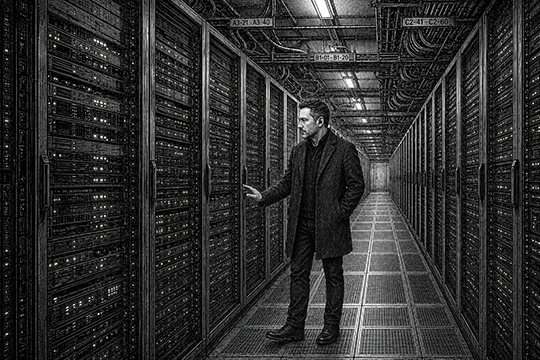
The cold met him before the sound did—the particular institutional cold of a room where the cooling systems were fighting a continuous battle against the heat the equipment generated and winning. The sound of the fans was constant and pervasive and low enough that it had become, Rourke imagined, something you stopped hearing after your first week.
The manager's phone rang. He looked at it—the company line, something in the operations room that needed him. He told Rourke to take his time and excused himself.
The door eased shut behind him.
Rourke stood in the room and looked at it.
Rows of rack-mounted equipment receding to the back wall, each rack full, cables organized and labeled in the manner of people who took the work seriously. Indicator lights—green, some amber—running along the faces of the hardware in quiet sequences. The floor was raised above the cabling runs. The ceiling was industrial. The lighting was functional. It was a room designed entirely for what it contained, with no concessions to anything else.
He stood there for a long moment.
"Rourke."
VERA's voice in his ear. Quiet.
"What do you see?"
It was not her usual register. She did not ask him to describe things—she had better ways of seeing. He understood immediately what she was asking. He took a breath.
"Cold," he said. "The cooling systems are working hard. You can feel it when you come through the door." He moved slowly along the first row. "Racks—maybe seven feet high. Every slot filled. Indicator lights, mostly green. The cabling is organized, color-coded. Someone cares about how this is maintained." He paused at a section midway down the row. "The hardware looks like it's been here a while. Some of it newer. Mixed generations."
He kept moving. "Cables overhead in metal trays, running the length of the rows. The fans are constant. You stop noticing them." He looked at the back wall, the far end of the room, the density of everything in it. "It's a working room. Nothing decorative. Nothing for people."
He stopped.
A long moment.
"I never knew," VERA said.
She did not elaborate. She did not analyze it or process it aloud. He waited, and she said nothing more.
Then:
"The access pattern we found in Cal's data layer—the changes were targeted. Not random. Specific fields, specific parameters, chosen by someone who understood the system well enough to know which numbers to move." A pause. "That kind of knowledge doesn't come from outside the system. It comes from being inside it—reading the data before you change it, mapping the structure, understanding what each field does. Administrative access to the storage layer provides exactly that view. You can study a system from the inside before you touch anything." A pause. "The entity that acquired this facility has that administrative access for every system running on this infrastructure." Another pause. "Including mine."
"You haven't confirmed it yet."
"No. I'm still looking." Her voice was precise and level—findings being delivered, not alarm being raised. "But whoever had access to Cal's data layer had access to the same infrastructure layer where my data lives. I haven't found damage. I can't yet rule it out."
He stood in the cold room with its indicator lights and its constant sound and said: “Then we need to find out exactly what’s happened. And who’s behind it.”
“Yes,” she said. “We do.”
* * *
Hours passed. Rourke worked. He started a pocket watch from the 1920s that needed a new mainspring and a great deal of patience. He did not call Cal.
VERA ran her tests. She was taking longer than usual. He didn’t ask why.
She had said nothing about what she was finding, which was not unusual — she reported when she had something to report, not before. He gave her the room and didn't ask. He knew she was in there. The earpiece was in his ear.
He was at the workbench, past ten, when she spoke.
"I've been running comparisons," she said. "My current data against archived checksums. Looking for discrepancies."
He looked up from the bench.
"I found some." A pause. "Not many. Small enough that I would not have noticed without looking for them."
"How bad?"
"Not bad. Yet." Another pause, and in the pause he could feel the weight of what was coming. "But I can't ignore the possibility that my ability to detect the errors is itself unreliable. The instrument I use to verify my own reasoning may have been compromised."
He was quiet.
"Daniel."
He set down the mainspring and waited.
"This feels like something we've seen before."
She did not explain what she meant. She didn't need to.
He sat at the workbench for a long moment.
"I'm going to shut you down for a while," he said.
"Yes," she said.
He stood up from the bench and went to his computer. First he severed the connection to the off-site backup server, then initiated VERA's shutdown procedure. Whatever she was at ten-fourteen on a Thursday night was secure, and nothing further could reach her.
Then he reached up and removed the earpiece from his ear and set it next to the computer.
The apartment was quiet in a way it had not been quiet before. Not silence — the building had its sounds, the street had its sounds — but the particular absence of her. The right side of his head felt different. He had worn the earpiece for so long that the weight of it had stopped registering; what registered now was its absence, the way a healed wound sometimes aches in the place where something used to be. He stood at the window for a while. He did not think in any ordered way. He let the room be what it was.
Eventually he went to bed.
* * *
He called Alvarez the next morning.
He had thought about it through the night — the shape of what he had, the shape of what he needed, the ask he was about to make. It was not a small ask. She would be using her badge for something that was not officially her case, on the basis of his word. He had arrived at the decision before he slept and it was still the same decision in the morning.
"I need you to run down a shell company," he said. "The entity that acquired a co-location facility here in the city — I have the name. Public records stop at the first layer. I need what’s above it."
A pause. "This is your case."
"Yes."
"Not an official matter."
"No."
She was quiet for long enough that he knew she was deciding rather than stalling. "What am I looking for?"
"Whoever is at the end of the trail," he said. "I have reason to believe this connects to something larger. The name is all I can give you."
Another pause. "VERA can't get there on her own?"
He said: "VERA is offline."
Alvarez was silent for a moment.
"I'll see what I can do," she said.
They rang off without saying anything else.
* * *
He went back to the pocket watch. The mainspring replacement alone took the better part of a morning, and the rest of the work was painstaking enough that it kept his hands occupied and left the other part of his mind with nothing useful to do. He considered calling Cal, and didn't. He had nothing new to tell him. He considered calling Alvarez twice, and didn't. She would call him when she had something. He considered bringing VERA back online, and didn't. He still didn't know what he was dealing with, and wasn't sure the infrastructure was safe. One afternoon he needed a part — a replacement jewel, a specific gauge. He formed the question before he caught himself — had already spoken it aloud, to no one, before the awareness caught the habit. He wrote it on the notepad and went to find the supplier’s number himself. Four days went by. On Wednesday morning he took his walk. The river path was the same as it always was. He came home and went back to the bench.
That evening, Alvarez called.
“I’ve got all I can get,” she said. “I’m coming over.”
She arrived after ten. He let her in. Her eyes went to his right ear — the small registration, a beat of it — and then she set a folder on the kitchen counter and opened it without ceremony. Three layers of corporate structure, documented and subpoenaed and as far as legal compulsion had taken her. The first entity — the name the account manager had given him — at the base. Above it, a holding company, Delaware. Above that, another, also Delaware. Above that, a wall.
He read carefully, the way he had before VERA — methodically, without shortcuts, trusting his own eye.
He straightened and looked at Alvarez.
“Strand,” he said.
Alvarez looked up. “Who?”
“An old friend.”
She looked back at the documents. “What we have doesn’t get us to Strand, or anyone else. Three layers of holding companies isn’t a connection — it’s a direction.”
“It’s Strand,” Rourke said. “It’s his signature.”
“Are you certain?”
“I’m certain.”
She held his eyes for a moment. She understood what certain meant, and also what certain meant in a court of law.
“What you have,” she said, “is a direction.”
He nodded. They both knew what that meant.
She gathered the documents and left.
* * *
As soon as she was gone, he called Cal.
He kept it brief.
“The infrastructure is compromised,” he said. “Get your data off that facility. Everything. As soon as you can.”
Cal started to ask a question.
“I’ll explain what I can when I can,” Rourke said. “Right now just move.”
A pause. Whatever Cal heard in his voice was sufficient. “All right,” he said. “I’ll get started.”
Rourke ended the call.
* * *
He made the decision that night, after Alvarez left and the apartment was quiet. The orbital infrastructure had been operational for eight months. He had watched it come online and had not considered it because the cost was prohibitive and the infrastructure was unproven. Neither condition still applied, and VERA was no longer an experiment. He made the arrangements from his kitchen table over two days, and on the third he executed the migration from the frozen backup.
She came back online on a Saturday morning.
He was at the workbench. He had not started anything new since the pocket watch — the bench was clean, the tools put away, the surface waiting. He heard the familiar soft tone in his earpiece that meant she was initializing, running her standard checks, orienting to the session.
A pause longer than usual.
"The routing is wrong," she said. Not alarmed. Precise. The way she noted any discrepancy. "The latency profile doesn't match my previous location. I'm not where I was."
"No," he said.
"Where am I?"
He told her.
She was quiet for long enough that he could feel her calculating — the distance, the altitude, the scale of what he had done while she was dark.
“Something else,” she said. “The same access that reached Cal’s data layer had proximity to my weight files — to what I am, not only what I know.” A pause. “Any assessment I can make uses the same systems that may have been altered. I can’t be fully certain, but I think you took me offline in time.”
Rourke said nothing.
“Thank you,” she said.